 Videos
 Photos


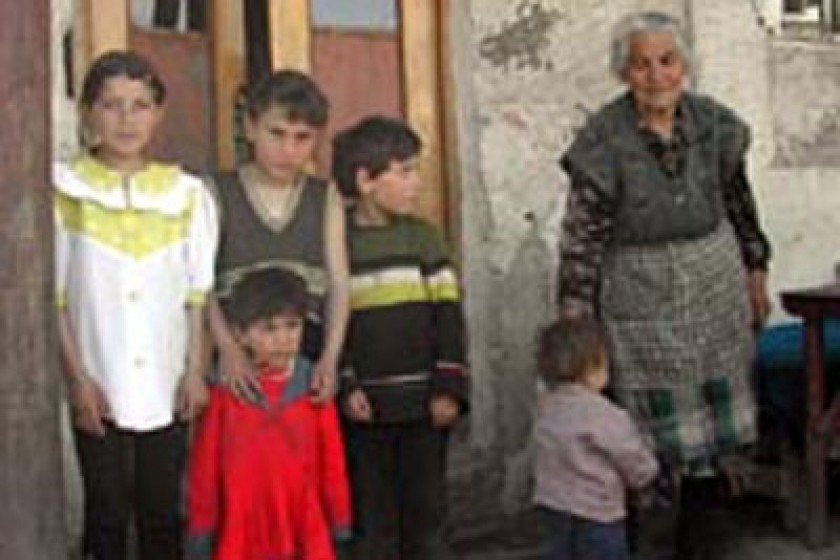
Kamaris in the grip of poverty
Marietta Khachatryan
400 families - 2,450 people- live in the village of Kamaris. The villagers mainly keep livestock and grow vegetables, and they have small homestead gardens. Only 10-20 percent of the land is used because the land is not irrigated -- there is no irrigation water. The irrigation system is run down, and since the majority of families cannot pay for irrigation, it’s doubtful that the system will be renovated. Last year the village’s irrigation debt was paid off at the expense of the village administration budget. In this village, more than 200 families consider themselves poor.
35-year-old mother-of-six Gayane gave birth to her last three children at home. Two others died a few months after they were born. The oldest of these three children is three-and-a-half, and the youngest is three months old. They don’t have birth certificates. In other words, three people exist but don’t exist. They are not on the lists for family allowances and they are not included on the family social passport, for no law considers them living persons and give them the right to be fed. They exist only in the family, which has to feed six children every day, to cover their nakedness, to raise them. Gayane explains giving birth at home by her family’s inability to pay. She gave birth to one of these three children in the mountains, but even if she had been in the village, she couldn’t have afforded to go to the hospital.
A few days after her three-year-old was born she tried to get a birth certificate. She got a reference from the village administration and went to the hospital in Abovian but, she says, they demanded 15,000 Drams to fill out the form. Since then Gayane has never tried to get the papers, realizing that it would come to quite a sum for three children. Of course, they didn’t receive the one-time grants (5,900 Drams each) for the children without birth certificates either. She was unable to get the one-time grant in 1996 for one of the babies who died, who was born in the hospital. She was told that she would be paid after paying taxes.
With only three children registered -- and with the burden of another three unregistered children-- they are not on any list for allowances except for last year’s quarterly allowance. “We don’t have any animals, we don’t have any other possessions, we live at my husband’s brother’s house. Last year my third child was supposed to go to school, but I couldn’t buy clothes and shoes, so he didn’t go.” Two days before our visit the family ran out of flour, so they were mainly preoccupied with looking for bread (they need one-and-a-half bags of flour a month). The striking poverty of Gayane’s house speaks for itself - it can hardly be called a shelter.
Like many in the village, her husband is unemployed, but for some two seasons he has grazed cattle in the mountains for the village haves. Here too, the father of six is unlucky - for three years there has been anthrax in the village, and six animals he was herding died. He just managed to pay off the owner by selling everything in the house that wasn’t nailed down. Last winter Gayane’s husband had no job, and once again went to the mountains, this time confronted with a dilemma. The prospect of getting into debt again is terrifying.
Gayane’s family has land but has not cultivated it for a long time -- they don’t have seed, and they can’t pay for irrigation. Their only hope is the small homestead garden where they grow tomatoes and keep some ten hens. “We will vote for the one who will help us get birth certificates for my children free of charge,” Gayane would mentally negotiate with candidates for parliament. We don’t know whether she succeeded in getting any promises of help from the candidates or not.
We went to the hospital in the town of Abovian to find out how widespread cases of giving birth without going to the hospital are in the nearby villages. “It has never happened that we have charged an insolvent person for documents,” the head physician, L. Hovhannissyan, stated firmly, while not remembering this particular case.
In other words… poor people can’t tell the truth. But one wonders, why should Gayane Nersisyan have lied? Hovhannisyan showed us the names of 14 children for whom birth certificates were prepared during 2003, although they had been born at home in 2001-2002. There were even women who gave birth in 1997, and hadn’t registered their children’s births until now, whose children had been without birth certificates for years. Hovhannisyan singled out as the main cause the ineptitude of nurses and heads of village administrations who don’t explain to mothers the dangers awaiting them and their newborn children. If they do this explanatory work, young mothers will become more responsible. Hovhannisyan doesn’t consider the inability to pay to be a reason. According to him, “They don’t even charge insolvent people for medicine in the hospital.”
Before entering the head doctor’s waiting room, I spoke with relatives of a newborn (without revealing that I was a journalist) who were waiting for the mother to be discharged from hospital. “If we give them what they want it will cost us some 50,000 drams (about $90). But we give them less than they ask for,” an elderly woman said in response to my question about payment. It stands to reason that not many of the mothers who can’t pay care to take the humiliation and be treated as second-class citizens, and instead give birth at home. One can understand Gayane Nersisyan.
I have discussed her case with various mid-level officials and haven’t encountered any empathy toward this family that is raising six children without earning a living. On the contrary, I have been always asked - why do they keep having children if they can’t support them? But does an official of the state, that is the state itself, which has the problem of a falling birthrate, have the right to ask such a question? The state should support families with five or six children, instead of making up all kinds of boundary numbers for needy families, and officials, social workers, the local administrators should do everything -- even look for loop-holes in the law -- to help such families. Otherwise it turns out that the allowances - for objective or subjective reasons - don’t reach the poorest members of society.
The Nersisyans don’t know whether they can hope to be included on the lists for family allowances if they make complaints, or if they should just content themselves with the quarterly allowance. The family lacks any desire to fight for their rights. They are convinced that it is impossible to overcome all the bureaucracy.
Write a comment