 Videos
 Photos


In the Wake of Resolution 106
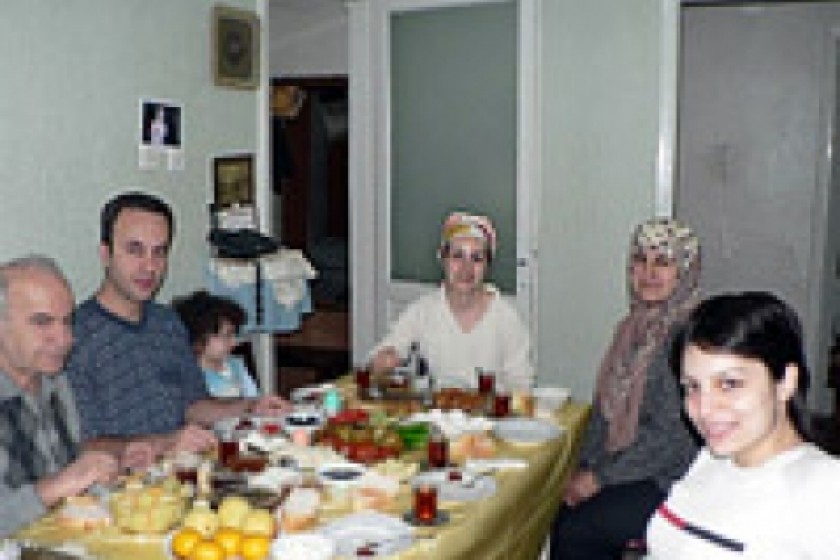
When I woke up in the morning Osman’s entire family was there to greet the guest from the neighboring country. He lived with his mother and father, his sister, and her two-year-old son. The table was laid in the living room and everybody was waiting for breakfast. By now the manifestations of hospitality that had seemed too much the day before were becoming usual and quite different doubts began to emerge in me - like, for example, whether open-heartedness, going out of one’s way for one’s guests was characteristic of Turks as well.
Had they perhaps become like this after mixing with us for so long? Or was it a sham designed to show how well they receive their “enemy”. Later, from my conversations with Osman I found out that his parents had nothing against accommodating a young foreigner and had not reacted at all to the fact that the foreigner was Armenian - “a guest is a guest irrespective of his or her nationality.”
After the Turkish breakfast I was well sated, but I felt somewhat uneasy since I had seen and tasted at the table a number of dishes very dear to me that I had to perceive for the first time as being Turkish. Osman’s mother had cooked the so-called “false dolma” very popular with us and explained that for dinner they usually cook it not with rice or other grains but with meat. Then they offered me doshab, again explaining how it was prepared, various preserves and comb-honey. Since this Muslim woman, like the other family members, didn’t speak English, Osman translated for us. He told me that his mother was a native of a village in the Eastern Turkey and they treated me to the bread baked by their grandmother living in that village which turned out to be just the lavash we know, but this time I ate it as a special Turkish bread. Osman told me that one cannot buy lavash in stores; it is served mainly in restaurants.
Osman’s nephew was a wonderful child and since he couldn’t even speak his native Turkish yet we communicated in the most common international language - smiles and gestures. Before I saw the child, when I had just learned from Osman that he had a little nephew, I thought that in any case it would be hard to feel warm towards him, since I arrived in Istanbul prejudiced. But the toddler captivated me so that I not only forgot his nationality, I regretted that I had not brought an Armenian souvenir for him, and I found myself hoping that perhaps one day my son would get to know and make friends with him. In fact all my prejudices disappeared completely, at least in this Turkish family circle.
As we parted, Osman’s mother took a souvenir from the cupboard - it was a plate with a picture of a mosque in her village. The plate is now hanging on the wall in my living room.
Osman and I decided to meet later at the seminar and I rushed to the city center to see the contemporary delights of timeless Constantinople.
Istanbul with its population of 15 million has a lot to offer a tourist; it is a city that contains the history of three notable empires of the world - Roman, Byzantine, and Ottoman. You can find the traces of all these cultures in Istanbul - with the prevalence of the Islamic culture. For example, the Saint Sophia Cathedral carries the heritage of all three Empires at once - originally constructed as a church it was later converted into a mosque and now is a Museum. And perhaps very few people know that the massive dome of that world-famous cathedral was rebuilt in the tenth century by the creator of the Ani Cathedral, the architecht Trdat.
Incidentally, this city populated predominantly by Muslims made an enormous impression upon me. Although loud calls inviting to prayers were heard five times a day from the mosques located at every step, both the outside appearance and the lifestyle of Istanbul Turks did not convince you that the city residents were indeed zealous Muslims. Later after discussing this subject with my young Turkish acquaintances I realized that the majority of educated Turks, who considered themselves to be something of an elite, are not in fact religious; they don’t pray even on Fridays and they perceive themselves Muslims more according to custom since “it’s an Islamic country and since my parents accept this religion therefore I’m Muslim too.” Many of the Turks I met didn’t go to mosques even during Ramadan and didn’t cover their heads.
In the center of Istanbul surrounded by crowds of tourists I always tried to avoid the question of where I had come from. When responding I was ready to lie saying that I was from, say, Spain or some other country, but not from Armenia - I felt uneasy among millions of Turks.
My biggest impression from Istanbul and, generally, from Turkey, was the ubiquitous adornment with flags. I knew that Turks were more devoted to their flag than other nations but I didn’t expect that the national flag could be such an idol. On the fronts of most diverse buildings in all parts of the city very large red cloths with Turkish crescents and stars were flapping. Even the beauty salons, stores, gas stations and windows of ordinary citizens were adorned with the national flag. When I asked my Turkish friends about this phenomenon, some of them said that the number of flags had increased in connection with the upcoming holiday - Republic Day (October 29). And only one more candid young Turkish man told me that the flag as a manifestation of national self-identity comes as a help to citizens every time the state is somehow threatened. By raising the symbol of the state, the citizens want to show that they stand beside their government and are ready to fight for their national identity. I had additional evidence of this when I attended the Republic Day celebration in a small Turkish town.
Seda Papoyan
Write a comment