 Videos
 Photos


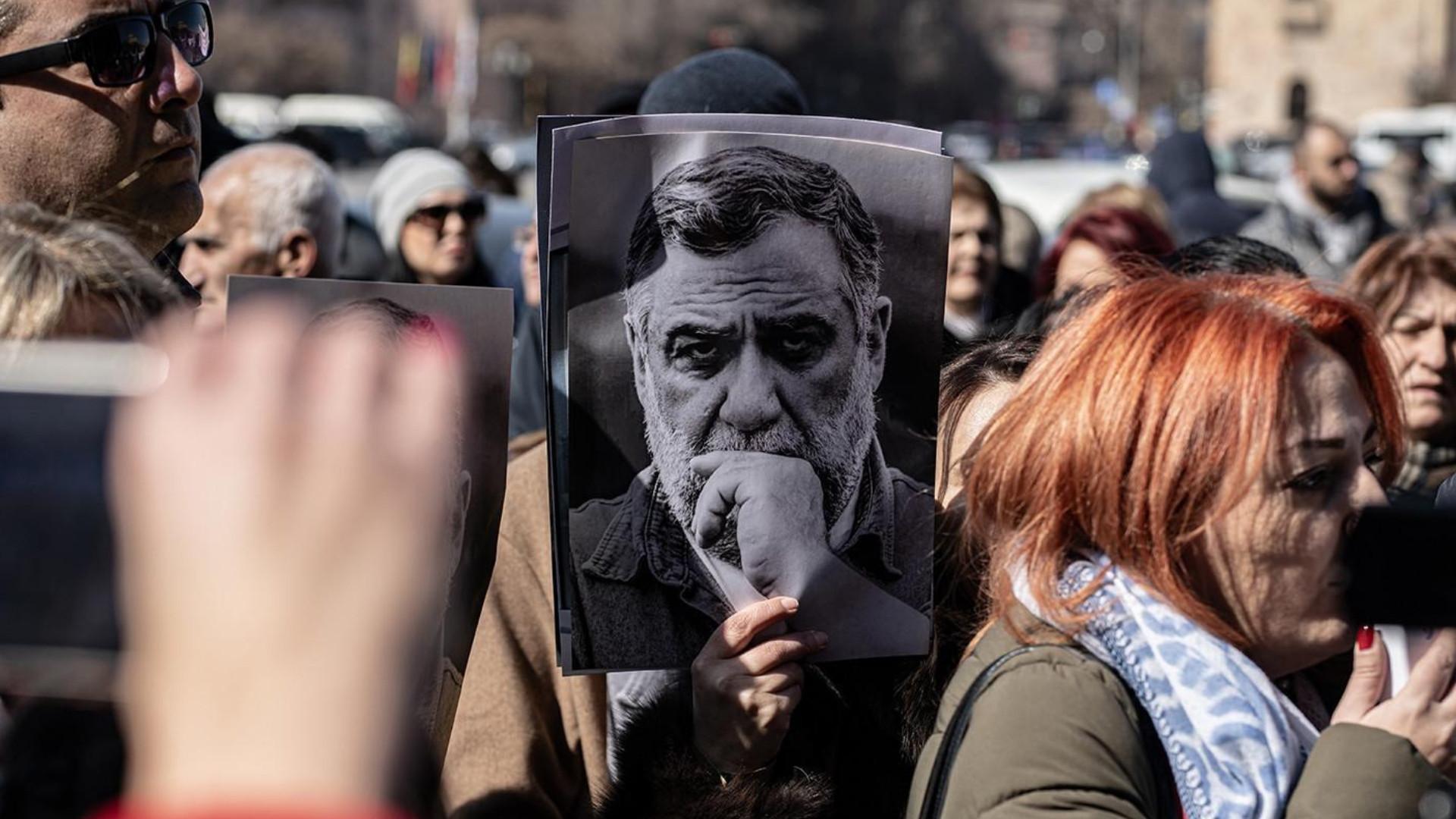
“The Oligarch’s Design”: How Armenians Wound Up In an Azerbaijani Propaganda Film
Some of the interviews used in the Azerbaijani film The Oligarch’s Design about Ruben Vardanyan were filmed in Armenia for another film and for a different topic. The interviewees and the organizer of the filming in Armenia, Michael Dishunts, say they were not informed that the interviews might appear in the Azerbaijani film.
On December 20, 2025, the YouTube channel of the Azerbaijani international TV channel AnewZ published a one-and-a-half-hour film about Ruben Vardanyan, an Armenian businessman and former state minister of Artsakh, who is imprisoned in Baku.
Ruben Vardanyan was arrested while crossing the Hakkari Bridge during the forced displacement of the population of Artsakh on September 27, 2023. He was then transferred to Baku and charged with several false charges, such as “financing terrorism,” “creating and participating in the activities of armed formations or groups not provided for by law,” “illegal crossing of the state border of Azerbaijan,” etc. After being taken to Baku, Vardanyan went on hunger strike several times, demanding the release of Armenian prisoners and a fair trial in Baku. Vardanyan was not given the opportunity to familiarize himself with the official indictment. He repeatedly stated that pressure was exerted on him, that he was subjected to physical and psychological torture. Vardanyan's international legal team was not given the opportunity to enter Azerbaijan and defend him. The legal process in his case continues.
The film was released in Azerbaijani, Russian, and English. The film includes excerpts from interviews with former Artsakh National Security Council Secretary, military and political figure Samvel Babayan (former Artsakh State Minister), Grigori Martirosyan (General Director of the We Are Our Mountains development agency founded by Ruben Vardanyan), Ruben Hayrapetyan (Assembly Chairman of the same agency), and Tigran Khzmalyan (political activist) given to Spanish TPTM Media, where they talk about Ruben Vardanyan and the activities of organizations that he was involved in. Meanwhile, the above people had agreed to give an interview for a film on a completely different topic.
The Oligarch’s Design: What is the film about?
The first part of the Azerbaijani film about Ruben Vardanyan is the 2019 investigation into the Russian money laundering system, the Troika Laundromat. AnewZ, without citing any sources, based most of the film on this investigation.
OC Media, having studied some of the internal working materials of the film’s production, found that a group of Turkish media workers with close professional ties to Azerbaijan were at the heart of the production. One of them, Atakan Kerkuklu, has previously presented several documentaries approved by the Azerbaijani government and toured Azerbaijani embassies to screen them, including a film on the Nagorno-Karabakh conflict. The other is Ömer Faruk Tunç, a senior producer at Anadolu Ajansı, one of Turkey’s largest state-owned media outlets
The film focuses on Ruben Vardanyan’s activities in Artsakh, especially during the 2022-2023 blockade. Presented in an extremely negative light, he is accused of causing internal conflicts among the people during the blockade in Artsakh, instigating separatism, and even inciting children to take part in military operations in Artsakh. The film’s description presents it as an investigative documentary, and there is no mention of the authors or producers.
The film presents as “experts” people involved in Azerbaijani state propaganda. For example, the former Azerbaijani foreign minister Tofik Zulfugarov (1998-1999) who served as Azerbaijani ambassador to Estonia and Latvia.
Excerpts from interviews with Farhad Mammadov, Orkhan Amashov, Arzu Zeynalabdieva, as well as several Ukrainian politicians are also included.
Among them, Farhad Mammadov visited Armenia in October 2025 as a representative of civil society in the Azerbaijani delegation. He was the head of the Center for Strategic Studies under the control of the President of Azerbaijan and is currently the head of the Center for South Caucasus Studies in Baku.
One of the interviews in the film is with Orkhan Amashov, editor-in-chief of the AnewZ media outlet, where his words are presented as “expert opinion.” He has been the editor-in-chief of AnewZ since 2024. On December 13, 2022, he participated in a gathering of so-called "eco-activists" in the Lachin Corridor. At that time, he was the editor-in-chief of the Azernews newspaper. Amashov presents himself as an international lawyer and political commentator on his social networks (Instagram, X) and programs, often makes speeches and gives interviews on the topic of Armenian-Azerbaijani relations.
All of them accuse Vardanyan of obstructing the peace process between Armenia and Azerbaijan, suggesting that Russian President Vladimir Putin sent him to Artsakh to disrupt the process.
Interviews filmed in Armenia
The interviews in Armenia were conducted in the same period, in September 2025, for a film on a completely different topic. The interviews were conducted by Portuguese journalist Carmen Dolores Francisco Marques, director of the Spanish film production company TPTM Media Spain. She turned to freelance filmmaker Michael Dishunts in Armenia to organize and film the interviews.
Dishunts says he was contacted by someone from Bulgaria (Dishunts refused to disclose the names or the organization) and offered to cooperate with Spanish TPTM Media journalist Carmen Marques to organize and film the interviews. Dishunts agreed to the offer. Marques presented a description of the planned film about Armenia and a list of people she wanted to meet for an interview.
Dishunts says he often organizes filming, and this was a normal request for him, and that the organization (TPTM Media Spain SL) made a serious impression, so he was not suspicious.
“My job was to contact the people on the list, arrange for an interview, and videotape the interviews. We organized interviews on a completely different topic, and here we simply provided the work of a camera operator, lighting engineer, and translator,” says Dishunts.
The list sent to him contained some ten names, of which Dishunts was able to talk and arrange interviews with four. Michael Dishunts and Carmen Marques refused to tell Hetq who the interviews were originally supposed to be organized with. The filming in Armenia lasted five days. After the film was broadcast, which also included interviews conducted in Armenia, Dishunts contacted Carmen Marques for clarification.
“The interviews conducted were not about Ruben Vardanyan, but during the interview the journalist (Marques - ed.) also asked questions about Ruben Vardanyan. The circulated film is in no way related to the film originally described,” says Dishunts.
Carmen Marques told Dishunts that TPTM Media allegedly abandoned the film project due to financial problems and was forced to sell the videos.
Who is Carmen Marques?
Hetq spoke to Carmen Marques, the journalist who conducted the interviews, and said TPTM Media abandoned the film project on October 22, 2025.
Internal documents obtained by OC Media show that Carmen Marques was one of the key players in the production. OC Media also found that Marques worked for the Turkish state-owned TRT World as a producer.
Carmen Marques contacted one of Hetq’s journalists in February of last year, posing as a content manager for TPTM Media and offering to collaborate on a documentary on a different topic. As a result of correspondence with Marques, the Hetq journalist, considering her activities suspicious, refused to cooperate. A film on the same topic, which Marques had proposed, was published by AnewZ on January 16, about a month after the film about Ruben Vardanyan. These facts allow us to assume that Carmen Marques filmed the footage specifically for AnewZ.
After the publication of the film about Ruben Vardanyan, Hetq contacted Marques for comment. She refused to explain why TPTM Media announced that it had “left the project” and how the interviews conducted in Armenia ended up in the Azerbaijani film, arguing that this was confidential information related to his company.
When asked how she selected the people for interviews, Marques replied that this was also confidential information and that she was not going to reveal her sources.
“I asked to be given the names of those with whom I was to conduct the interviews. I do not know Armenia, and I conducted the interviews with those I was told to do so,” she noted.
Marques says that after leaving the project, she was not aware of the fate of the videos, but “the material appeared on the market and was given to someone or a distributor, from where the Azerbaijanis bought it.”
Hetq asked Marques how the sale of those videos was possible if the people interviewed in Armenia agreed to speak for a specific film.
“When I did the interviews, they signed a document where they agreed that the interviews could be used in various places, they could be transferred to distributors. From a legal point of view, they can do nothing,” Marques replied.
However, when we asked to see that document, Marques said that it was also confidential information and was not subject to publication.
Dishunts says the interviewees gave written consent to use the footage in the film, which cannot contain a clause about their sale. The interviewees in Armenia also note that they did not give any consent to use their interviews in any other film, including an Azerbaijani film, or to sell them to anyone. Their consent was for a specific film.
After sending an official request to TPTM Media and receiving no response, Hetq tried to contact Helena Aviles, who is presented as an employee of this company on the TPTM Media website (https://www.tptm-media.com/, the website is currently inactive), to receive an official explanation. After our inquiries, Carmen Marqueս wrote us a letter, officially introducing herself as the head of TPTM Media and urging us not to pester the company's employees and anyone who collaborated with them in the framework of the film.
TPTM Media Spain SL Limited Liability Company was founded in February 2020. According to open sources, Carmen Dolores Francisco Marques has been the director of this company since its inception. She hid this fact during our first conversation, introducing herself as a TPTM Media journalist and head of the company's London branch.
Marques also wrote to us that she never claimed that the company abandoned the film project due to financial problems, thus contradicting herself.
Marques added that all questions related to the film should be addressed not to her, but to the Azerbaijani media outlet that distributed the film, and that neither she nor TPTM Media bear any responsibility for what happened.
What was said in Armenia, and what was used?
The interviews in Armenia were conducted with Samvel Babayan, Grigori Martirosyan, Ruben Hayrapetyan, and Tigran Khzmalyan. The interview with Samvel Babayan was organized by noting that the film would concern Armenia’s European integration, the situation after the 2023 Artsakh war, and Armenia’s development prospects. For example, when organizing the interview with Grigori Martirosyan, there was no mention of these topics. He was told that the interview would be about the We Are Our Mountains development agency founded by Ruben Vardanyan, of which Martirosyan is the general director.
Martirosyan says the interview was about the programs implemented by the We Are Our Mountains agency in Artsakh and Armenia, the organization’s impact on people’s lives, and Ruben Vardanyan’s role in all of this.
From the interviews that lasted more than an hour, several minute-long segments were included in the film. In particular, the segment from Samvel Babayan where he talks about Ruben Vardanyan holding a state position in Artsakh.
Segments from the interview with Tigran Khzmalyan regarding Ruben Vardanyan were also included. In his speech, Khzmalyan says that “Ruben Vardanyan was a Russian agent and was sent to Artsakh on a special mission.”
In an interview with Hetq, Khzmalyan noted that he does not regret what he said, he only regrets that it was used in an Azerbaijani film.
“They were ordinary questions, I did not see anything suspicious, only at some point did they focused on Ruben Vardanyan, which was normal for me, since there were also questions about Pashinyan,” Khzmalyan says.
Excerpts from the interview with Grigori Martirosyan about the We Are Our Mountains development agency have been included, where Martirosyan talks about its activities in Artsakh, the David Bek initiative(a youth camp providing physical training alongside classes in ethnographic songs and dances.), and Ruben Vardanyan’s activities during the blockade.
The “unmade” film about Armenia
In a document sent to Mikael Dishunts, which was published on Samvel Babayan’s official Facebook page, Carmen Marqueս presented a description of the film about Armenia. The title of the film was to be Bridges at the Edge: Armenia Between Continents. According to this document, the documentary would present Armenia as “a country with deep cultural roots that is trying to find its place in a changing world.”
According to the document, the film was to include the growing relations between Armenia and the EU, the role of youth and civil society in promoting democratic and governance reforms. The next part was to talk about how the 2023 Artsakh events affected national priorities and political discourse. It is said that the goal of the film is to present Armenians to the world as Armenians see themselves.
The document states that the film is in production and will be presented at the MIPCOM platform for international distribution. At the same time, it is said that they are “in talks with Fremantle and Netflix, who have expressed some interest in the topic.” The film’s director, according to the document, is Jake Swantko, who is the producer of the 2020 documentary The Dissident.
Hetq has attempted to contact Jake Swantko to find out if he has any connection to the film project about Armenia. He has not yet responded to our emails sent via social media.
Accreditation is mandatory
Hetq sent a request to Armenia’s Ministry of Foreign Affairs to find out whether anyone from TPTM Media Spain, Carmen Marques, or the company itself has applied for accreditation in Armenia, for conducting interviews, or for producing films. The ministry says it hasn’t received any such application.
According to Armenia’s Law on Mass Media and a directive of the Minister of Foreign Affairs, the activities of a journalist visiting Armenia acting on the basis of the legislation of a foreign state, must be carried out in Armenia exclusively if he/she has appropriate accreditation from Armenia’s foreign ministry.
Hetq asked Carmen Marques why she or the company did not apply for accreditation. She did not respond and requested that no further attempt be made to contact her.
Hetq also asked the AnewZ for an official comment on how the interviews intended for another film appeared in the film about Ruben Vardanyan. The Azerbaijani media outlet did not respond.
Lawyer Ara Ghazaryan explains that copyright for interviews is shared, so using them without agreement violates copyright law. If contracts do not clarify ownership, the law applies. Interviewees can ask for a film to be withdrawn if their words are distorted and may seek legal action in Armenia, where the case occurred.
This story shows how videos made by simple deception, under the pretext of making another film, whether it is an interview or other footage, can be used for the purposes of Azerbaijani state propaganda, without the consent of the interviewees and without public responsibility. Azerbaijan spends a lot of money on state and anti-Armenian propaganda, often using journalists and organizations from other countries.
While all parties involved remain silent, the question remains: who and what is responsible for the materials filmed in Armenia but used for other purposes.
Top photo: Narek Aleksanyan, Hetq
Comments (1)
Write a comment