 Videos
 Photos


No Tap Water in the Village of Mets Tagher
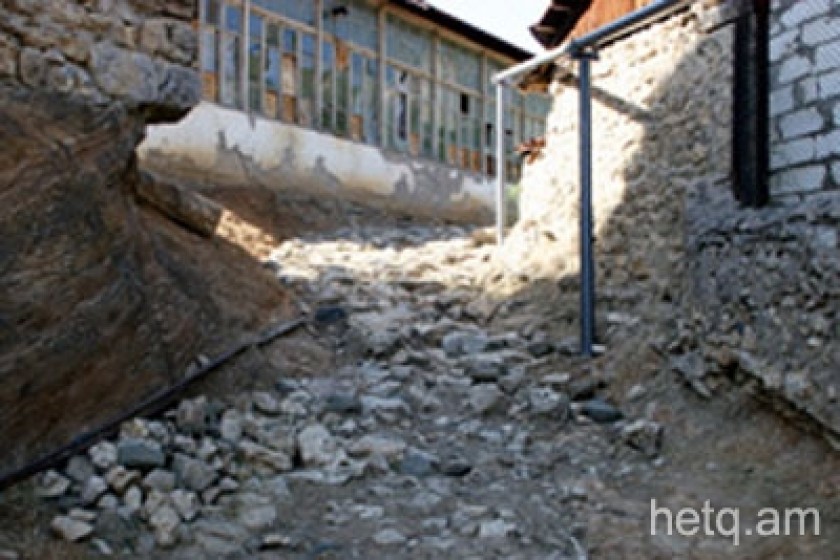
The road is so destroyed that you would never guess that it leads to the village of Mets Tagher with its 1,507 residents and 300 years of history. We are smothered in dust. We have finally reached the office of the village administration. The local mayor is not there. We are told that he has gone to a wedding party. We find him among the guests at the wedding; he is the toastmaster. “It's a duty I have to carry out,” he tells us and comes with us outside. Together we walk to the administration office. The mayor's desk is buried in dust. He wipes it clean. After five minutes it's again covered by dust. We talk. His style is educated and passionate. “Mets Tagher was far from the frontline but we had 39 people killed during the Artsakh liberation war,” he says. They could have been proud of the self-sacrifice of fellow villagers if the life of those alive was anywhere close to acceptable living standards.”
Leaving the office, we notice a plaque near the entrance. “I am your son; don't forget me,” the inscription reads. It was made to immortalize the memory of 286 residents of Taghlar [now Mets Tagher] killed during World War II.
We walk toward the village center. This is one of the rare villages in the Hadrut region where there is a town-like everyday life – they have a beauty shop with modern equipment and furniture, and a modern kindergarten. “We have taken 90 children off the streets and are taking better care of them than their parents,” the village mayor says. There is also a carpet-weaving shop that employs eleven people. The carpets are sent to Yerevan.
There is a community hall in the village with a computer room for young people on the first floor. A group of schoolchildren are working on computers, but most young people spend their time outside. There are no jobs and they follow the cars that come and go as they eat sunflower seeds. The North-South highway being built with finances raised by Hayastan All-Armenian Fund is just three kilometers from the village. The villagers appealed to the Hadrut administration asking them to include the three-kilometer road to the village in the asphalt work but they were turned down.
 |
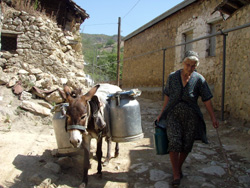 |
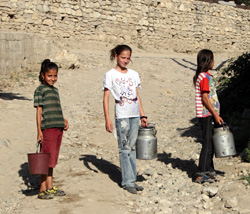
One can see horses or donkeys laden with cans and children and adults carrying buckets, bottles and other containers at every turn in Mets Tagher. Everyone goes toward the only spring in the village, collects water, and returns home. Sixty-seven-year-old Zarik Javakhyan comes for water with her donkey laden with cans three times a day. “It's not a life, son,” she says. The village administration alone is unable to solve this problem. They've heard about the Hadrut Revival project approved by the Hayastan Fund and are waiting for the telethon in November.
A narrow brook flows though the village on the banks of which some villagers have laid out vegetable gardens. Most of the gardens are not irrigated. “We just wait for the rains,” the locals say. For that reason they don't grow grapes or other plants that require care; instead they grow only wheat, which doesn't require much water. The arable lands that are located 20 kilometers away from the village are not irrigated, either. There hasn't been a single drop of rain in Mets Tagher for more than a month now.
There are many young people in the streets. But only boys. Twenty-two-year-old Hakob returned to Karabakh from Russia four years ago to serve in the Army. Now, with no future prospects, he's getting ready to leave again. The village mayor says that 161 people left the village between 1988 and 1998. In the recent years fewer people have left; villagers live at the expense of their relatives who work abroad.
Mher Arshakyan
Write a comment