 Videos
 Photos


As 2005 Comes to an End
Knarik Meneshian, a teacher and writer from Glenview, Illinois, wrote the poem and essay printed below on the 90th anniversary of the Genocide. In her introduction to the pieces, she explained, “Every time a young girl is lured or forced into prostitution; every time a person or a family is evicted from the home they live in to make room for new developments, with no thought given as to where or how the evicted will live; every time the indigent or homeless are denied medical attention or hospital care because they cannot pay; every time the elderly, the mentally ill, the disabled, the orphaned, and the impoverished are neglected or abused; every time members of the news media are intimidated or silenced because they care enough to bring to light that which needs to be changed in the country, we disrespect and dishonor the memory of our one-and-one-half million martyred Armenian men, women, and children, who perished at the hands of the Turkish government in Western or Turkish occupied Armenia in 1915, because of who and what they were.
“No matter how many candles we light, prayers we say, hymns we sing, speeches we give, and flowers we place at memorial monuments each April 24th, they all mean nothing if there is no kindness, no charity, no compassion for our fellow Armenian, whether in the Hairenik or the Diaspora.
“As 2005 comes to an end, the year we observed the 90th Anniversary of the Genocide of the Armenians, let us prepare for the new as we say farewell to the old. Let the New Year, 2006, be the year we begin treating each other with more kindness, charity, and compassion as we work together, no matter who we are, where we come from, what church or organization we are affiliated with to make a stronger Armenia and Armenian Diaspora!”
As the Earth Flowed Red
The old woman Takouhi
Watches the fly
Climb up the window screen.
She blinks
As wind blows strands
Of white hair across her face.
Pressing her crooked finger
Against the screen,
She points
To pink roses spotted brown,
Half-shriveled tomato plants
Sprawled on the ground.
And she remembers…
Her mother and father
Dead in the fields,
Her baby brother
Tossed in the river,
And her big sister
Dragged away by men-
Long ago,
When the heavens screamed
As the earth flowed red
On land where her people lived.
Takouhi, called Queenie
On this new land that’s been so good to her,
Looks at her rough, knobby hands,
And she remembers…
When they were soft and plump
As she stroked her mother’s face-and they smiled,
As she touched her father’s prickly chin-and they grinned,
As she held her sister’s hand-and they sang,
As she played with her brother-and they laughed,
The day before
The heavens screamed
As the earth flowed red
On land where her people lived.
Takouhi blinks
And wipes away tears
As she remembers…
Her people-the Armenians,
The day
The earth flowed red.
April 24, 1915
Knarik O. Meneshian
February 2005
April 24 th and the Ruins of Ani
A river separates the present from the past. And so I sit here, on a hilltop that overlooks Ani, the ancient, crumbling city of a thousand churches. I look at the ruins before me, so close and yet so far. Unable to touch its stones, I pick some wildflowers and toss them to the sky. It is April 24 th -Day of Remembrance for Armenians everywhere. As they solemnly gather, men, women, and children, in churches, centers, and at monuments, with heads bowed in reverence, they pay homage to the one-and-one-half million Armenian men, women, and children-three-quarters of the entire Armenian nation-annihilated in 1915 by the Turkish government in Western or Turkish-occupied Armenia.
Today, here, under the sky of Eastern Armenia, I bow my head in reverence and silent prayer. All around me on this hilltop there is quiet except for the sound of the wind and the gurgling river below. Looking at the ruins and the vast open land before me that leads to Erzerum, Van, Bitlis, Sivas, Kharpert, Diarbekir, Adana and all the other towns and villages that were once Armenian, I think of our martyrs and the horrors they suffered.
I remember looking at reports in the Chicago Daily Tribune -"April 29, 1915- Armenians Flee For Safety . Turk Soldiers Massacre 800 Christians . Details From Urmia, Stating Some Were Crucified And Burned Alive .May 1, 1915- Recent Massacres In The Whole Region Of Lake Van .May 6, 1915- Turks Destroying Villages .May 8, 1915- Many Armenian Women Sold As Slaves .May 18, 1915- 6,000 In Armenia Slain By Turks ." Preserved on microfilm, one report after another describing the slaying of a nation.
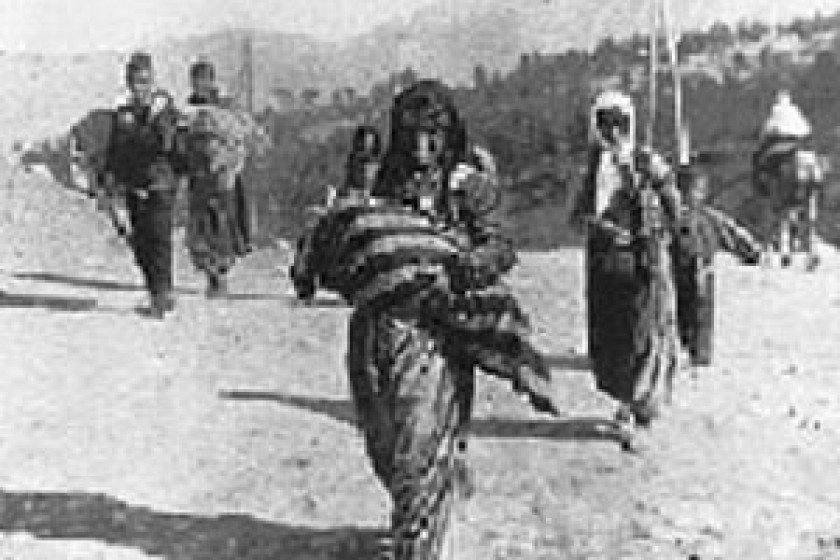
And then I remember the times I spoke with some of the survivors who, like my family and I, made Chicago their home: Aristakes of Sepastia, except for a brother, his entire family, including his young bride and unborn child, massacred. Margar of Kharpert, most of his family drowned in the river, like many of the villagers there. Manoushag of Dikranagert, most of her family massacred. Takouhi of Sepastia, her entire family massacred. Vartouhi of Divrig, except for a sister, her entire family massacred. Even though they came from different towns and villages, they all had the same anguished look in their eyes when they described the atrocities and the brutality of man against man they had witnessed and survived. In rivers, they were drowned. In churches, they were burned. In towns and villages, they were hanged, beheaded, slaughtered, buried alive... Girls and women were raped and dragged away, forced to worship another god. On parched and dusty roads, of thirst and starvation, they perished. But miraculously, some of them survived.
Today, because of our martyrs and survivors, we Armenians, no matter where we live or who we are, no longer live in fear because of who and what we are-Armenians and Christians. No longer do we hang our heads in servility. Their undying spirit taught us the meaning of courage, determination, perseverance; and the significance of helping one another. For it was in the helping of one another, that enabled those that survived to persevere, whether on the roads and rivers of death, or later in the orphanages.
Looking again at Ani and thinking of the problems here in Armenia and in the Diaspora Armenian communities, I wonder, Are these ancient ruins a symbol of the great culture that once was and can be again, or a harbinger of things to come if we do not take care and nurture what we now have, not only here in Armenia, but in Armenian communities everywhere?
Not far from where I sit, down a meandering, dirt road, a few old houses stand. It is quiet there today, but tomorrow the children will resume their play and the adults their work in this little place beyond the hill where time keeps beat to the rhythm of the land. And like their fathers before them, the people in this remote hamlet observe the old ways like the gyughatsees or villagers before them. For they are the keepers of our traditions, dialects, cuisine, art, folk songs and dances. They are the key to what makes our heart sing with longing. Their songs are the ones the great Gomidas-celibate priest, composer, vocalist, musicologist, and Genocide survivor-collected as he traveled from village to village.
In the cities and towns, however, the old ways are discarded and forgotten as the new are fervently and quickly embraced. Both are good and both are needed, just like grandparents and grandchildren. But in the cities, the people call the villager geghatsee , an unkind way of saying gyughatsee -f orgetting that at one time many of them also came from villages, some even from beyond Ani, where there too time kept beat to the rhythm of the land and the people observed the old ways. And in the Diaspora, where time keeps beat to the rhythm of swift change, new ways and things, there too is a lack of kindness towards one.
This April 24 th , whether we live in Armenia or the Diaspora, as we gather to honor our martyrs either through a church service, a moment of remembrance, a memorial program, a bouquet of flowers, a lit candle, or a solitary, silent prayer, let us honor them even more by treating each other with kindness. This year, on the occasion of the 90 th Anniversary of the Genocide of the Armenians, let us begin to strengthen Armenia and the Armenian Diaspora, and let it begin with kindness, embraced with compassion, charity, and unity, so that we too can become the keepers of our traditions, forever merging the old with the new.
Knarik O. Meneshian
April 2005
Write a comment