 Videos
 Photos


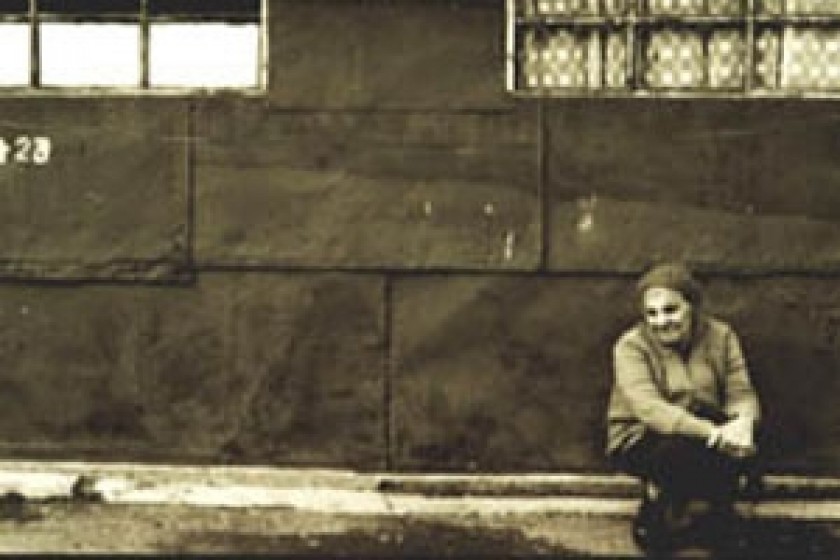
Nane's World
...And our eyes turn their yearning gaze
Upon the distant stars,
Upon the limits of the heavens,
Wondering when a bright morn will break
In the Armenian mountains,
Those green, green mountains.
The Armenian Mountain by Hovannes Toumanian
It was the season between summer and winter when I spoke with Nane, a local college graduate, as we walked down Khrimyan Street in Gyumri , Armenia 's second largest city. Pausing for a moment in front of the public library, a cold, dimly lit, damp and musty smelling place in need of renovation but staffed with librarians eager to help, my husband Murad and I had been here before in search of books on Armenian literary figures.
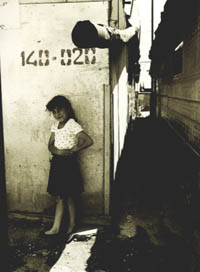
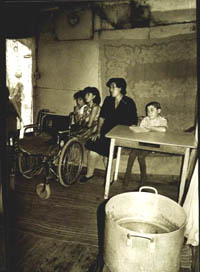
"I want to talk to you about my world in Gyumri, the place where I was born twenty-two years ago and where my family still lives in one of the many domiks that remain part of the city's architecture since the 1988 earthquake," Nane explained. "The population before the earthquake was about 250,000. Now, it's about 80,000 with nearly 7000 people still living in 'temporary' accommodation."
"I don't see a future for most of us here, especially for people my age," she replied when asked what kind of a future she envisioned for herself in the city that she loves so much. "There is no life here. Everything is dead," this bright and articulate young lady continued. "No matter how much construction goes on in this city things will never be the same. People continue to leave because they have no work. They have no other choice. The taste and smell of Gyumri is gone."
As Nane said these words, I remembered the young man I met in the shuka (open market) a year earlier in late October 2002. My husband Murad and I had just settled in Gyumri to begin our year-long volunteer work as teachers and it was a sunny, cool day and dust was everywhere. The young man was about Nane's age, tall and thin, with a pensive face and weary eyes. The market was almost like a scene out of an old western movie where the cowboy stands against an old squeaky door watching the dust swirl in the air, staring out into the openness waiting for something to happen.
He was standing, with his arms folded, in the doorway of the small store I wanted to enter to buy some soap and laundry detergent. Looking at me and then at the street he said, "Ay, kuyrik jan, inch es anum aysdegh ays posheot, kandvatz kaghakum? Inchi es ekel? Aysdegh ban cheka." Oh, sister dear, what are you doing here in this dusty, ruined city? Why have you come? There is nothing here." Even today, I cannot forget the hopelessness and weariness in the young man's eyes and voice.
 |
 |
As the days and weeks grew into months, Murad and I became more and more familiar with the people and their lives in one of the oldest towns in Armenia , which has a history dating back to the Bronze Age. Similar sentiments as those expressed by the young man in the shuka would be uttered by others as well. They would be spoken over and over again by different people albeit in different ways and as time passed, it became clearer as to what it all really meant. Even complete strangers would tell us their woes.
Sometimes they would talk about their lives as we rode the avtobus, sometimes on the marshrutka and at other times when we walked. When we took a cab, the driver would tell us of the difficult living conditions and all would speak of the life they had before their world was turned upside down. Many would longingly reminisce about "the old Soviet days when life was good, when everyone had food to eat, a warm place to live, people had jobs, and there was law and order."
But it wasn't simply what they said about their lost faith, hope, and dreams for the future, it was the tone in which they said it that filled one's heart with heaviness and pain. "Aye balas, es inch gyank e?" (Oh, my dear, what kind of a life is this?) said an old woman as she struggled to push her large wooden cart filled with parsley, cilantro, and onions down Rishkov Street towards the shuka one chilly and windy day.
And on another day, three men -- one appearing no older than fifteen with the oldest in his sixties -- pushed with great effort a wooden cart heavy with scrap metal up Garegin Njdeh Street north towards the Ani District. The men appeared frail and jaundiced and they were dressed in shabby clothes and worn-out shoes. They stopped from time to time to rest and wipe the sweat from their faces before continuing up the street. They said that together they would earn 2000 drams ($3.50).
To envisage how difficult it is to make ends meet, and specially with such meager and erratic earnings, consider the following prices: a loaf of bread costs 100 drams (17 cents), an egg between 40 and 80 drams (8 and 14 cents) depending on the season, a kilo or 2.2 lbs. of local Chanakh cheese 1000 drams ($1.75) at the shuka and 1200 drams ($2.00) at the grocery store. Beef costs 1000 drams a kilo and frozen chicken, 1100 drams. Electricity in the daytime costs 25 drams or 4 cents per kilowatt-hour (in Chicago it is 8 cents a kilowatt-hour) while a 20-kilo balloon of gas to use for cooking costs 8000 drams.
For people with no income or very little income, one cannot imagine how they survive. "Khaytarag vijak eh! It's a terrible situation! People cannot make a living now. They cannot pay their water, electricity, heating bills...People should not still be living like this after all these years, " said an unemployed father of three.
Another father of three, who sells his wares in the shuka from morning till night in a little booth that costs 1000 drams a day to rent explained that he was preparing to go to Sadakhlo, the market situated in Georgia , with a group of men to purchase items to sell in the shuka. "It is a dangerous trip and each time I go, my wife and children are always worried that something will happen to me but what can I do? I have a family to take care of and children to feed."
"You see that over there," said a friend, pointing to the bridge on Alex Manoogian Street , as we were out walking one day. "People jump from it just like they do in Yerevan because they don't know what else they can do anymore..." And as we looked at the bridge with Mt. Aragats towering in the distance, Murad and I remembered with great sadness the incident a week earlier in Yerevan.
One unfortunate person had done just that and put an end to it all by jumping off a bridge. Traffic had stopped and people swarmed around the area, leaning over the railing to witness the tragic event. According to one local, such incidents happen every month in Yerevan and sometimes there are as many as five or six. Of course, there are those who live well. Extremely well, in fact.
"I think we need another ten or fifteen years before people maybe decide to return home to our beloved Gyumri," said Nane as we continued our conversation. "Perhaps by then there will be work and the reconstruction of the city will be complete. Until then, people leave here with heavy hearts. They don't want to, but they must. It's a matter of survival."
And as we walked down Khrimyan Street , the Mayr Hayastan statue, standing like a fearless sentry, came into view ahead of us along with the Academy on one side of Sayat Nova with the Shirakatsi Institute opposite. Cater-cornered from the Academy was the Millennium Restaurant, which occupied part of a building that prior to the earthquake was a large stocking factory that employed a great many of the city's residents. "After the earthquake, the machinery disappeared," explained the former employees of the factory.
Approaching the square, we paused briefly to take in its sights and sounds -- to watch the traffic and the people pass by. People were walking towards the bus stop near the restaurant while others were making their way to the nearby stand that sold newspapers, candy, cigarettes, and other small items. A few strolled about or simply stood talking.
"One day you and Murad must visit the cemeteries here," said Nane. "There are three of them. The largest is where abandoned children and others beg. What a heart wrenching sight you will see, especially at dusk."
"A few of them live in the cemetery in small huts and they eat whatever is left from the funerals," she continued. "As you may know, it is customary in Armenia to leave food and drink for the dead at gravesites so when the mourners leave the beggars eat the food instead. It is so painful to see this. The local authorities are well aware of the situation but they don't even try to do anything to help these people. It's survival -- it's all a matter of survival. Take me for instance, if I had a full-time job I would never even think of leaving Gyumri. Why would I? I have family and friends here whom I love. Life without them would be a meaningless and monotonous existence for me. I would not be living."
After Nane said this, I thought back to the day Murad and I were coming out of the library at closing time. We were the last people to leave and as the door was locked behind us, a little girl aged around twelve and wearing boots and a coat so tattered that they should have been discarded long ago tried to enter after us. "Pak e. It's closed," we said to her. She looked up at us and then down at the book she had placed in a worn-out, clear plastic bag.
"Are you returning the book?" we asked. "Ha (Yes)," she shyly whispered before turning to walk back in the direction she had come from. "Are you going back home?" we asked. "Ha," she answered, looking at us with a sweet and innocent smile before turning her attention back to the plastic-covered book. She stroked it tenderly, reverently, and then looked up at us with that smile again.
"Inch es kartum? (What are you reading?)," we asked and she handed the book to Murad. It was a book of Hovhaness Toumanyan's hekyatner or fairy tales. "Did you enjoy the book?" we asked. Smiling, she nodded. "What's your name?"
"Anna," she whispered.
"Do you have any brothers and sisters?" Anna shook her head and replied, "I have a mother, but she's always sick and in bed."
"Is your father at work?" Anna shook her head and then replied. "I don't remember my father. My mother said he died when I was a baby."
"Do you live far from here?"
Anna pointed straight ahead and said, "No, I don't live very far from here. My mother and I live at the hanrakatsaran." The hanrakatsaran is a building where, during the Soviet days, workers used to live, especially those coming from the other Republics and Russia to work in the factories. Recently, part of the hanrakatsaren, which already had a big gaping hole in it, collapsed.
"Are you hungry?" we asked. Anna nodded shyly.
We asked her if she knew of a nearby grocery store and Anna reached for our hands and held them tightly as she led us to the store. She smiled as we entered and we told her to select the food and drink she wanted. Picking out the sausage, bread, cheese, butter and a bottle of Coke, she then shyly pointed to the imported bananas and oranges. We nodded and she smiled, her eyes sparkling. As Murad was about to pay for the groceries, Anna asked, "May I get two more things?"
"Of course," I replied, "what are they?" Anna took me by the hand and led me to the counter where school supplies were sold. She pointed to a pencil and then an eraser. I asked if she needed anything else and she replied, "No, that's all."
"You shouldn't do that," said the shop assistant angrily as Murad paid for the bag full of groceries. "This girl is in here all the time begging for bread. Her mother is an anbaroyakan -- she is immoral." Anna quickly reached for the bag as if fearing we would change our minds. Saying our farewells to Anna, Murad put her book of fairy tales in the grocery bag and she smiled her sweet and innocent smile once more. "I'm going home now to make something for my mother to eat," she said.
A few days later, we bumped into Anna and her mother on our way home from the shuka. "Mama, these are the people I told you about," she said, holding her mother's hand and smiling that beautiful smile of hers. The young mother, who looked disheveled with missing teeth and stringy hair, was thin and sickly-looking and was wearing the boots her daughter had worn when we first saw her. In between her coughing, the mother thanked us. "Thank you for what you did for my daughter... A long time ago I once had a job... but now there are no jobs. Could you please spare some money for some bread?"
It was obvious that the woman was distraught. Murad and I looked at each other, then at Anna, wearing her tattered coat and flimsy, worn-out shoes and then returned our gaze to the mother. She too was wearing a tattered coat just like her daughter and Murad handed her some money. The woman, holding the bills tightly in her hand, continued. "We have no one. I lost my husband years ago and we have no one. I don't know what to do." Then they walked towards the grocery store.
After notifying two prominent charitable organizations in Gyumri about the child and her mother, one of the organizations delivered food and clothes to them and the other organization helped in other ways. "We've seen cases like this before," said one of the Directors. "Something must be done to help the young girl and her mother because in a year or two, when she turns 13 or 14, her mother will be forced to put the child to work for 200 drams (35 cents) a customer."
I asked Nane what future she saw for Armenia . "Before answering that," she replied, "I want to tell you what I would like to do. I would like to move to Yerevan even though I doubt that I could find any kind of employment there or any real friends. To answer your question, if I can't see a future for myself in Armenia , how can I possibly see any kind of a future for Armenia ? Nowadays, there is only the superficial appearance of a stable life and economy."
"When a visitor sees Yerevan ," she explained, "he or she compares it to Paris but when you look carefully at the people, you see that their souls are sad. When you see the girls in Yerevan , you admire their beauty but few are happy. They have worries and the first and most important thing for them is their economic situation. Any concern about the future is secondary. Some girls are forced into doing things they don't want to do but they must because they have to live, they have debts and they have no other choice. Armenia is a world of illusions and paradoxes."
And as Nane and I finished walking, I could not help but wonder about her future, the future of the little girl we had met as well as many others like her and the future of all the students we had come to know from grade school to college students and graduates. Would they realize their dreams someday in their -- in our -- beloved Hayrenik?
Knarik Meneshian
Photographs by German Avagyan
Knarik Meneshian, an American-Armenian from Illinois , and her husband lived and worked in Gyumri for a year with the Armenian Volunteer Corps (AVC). Anyone interested in assisting NGOs and vulnerable families in Gyumri can contact her at [email protected].
Write a comment