 Videos
 Photos


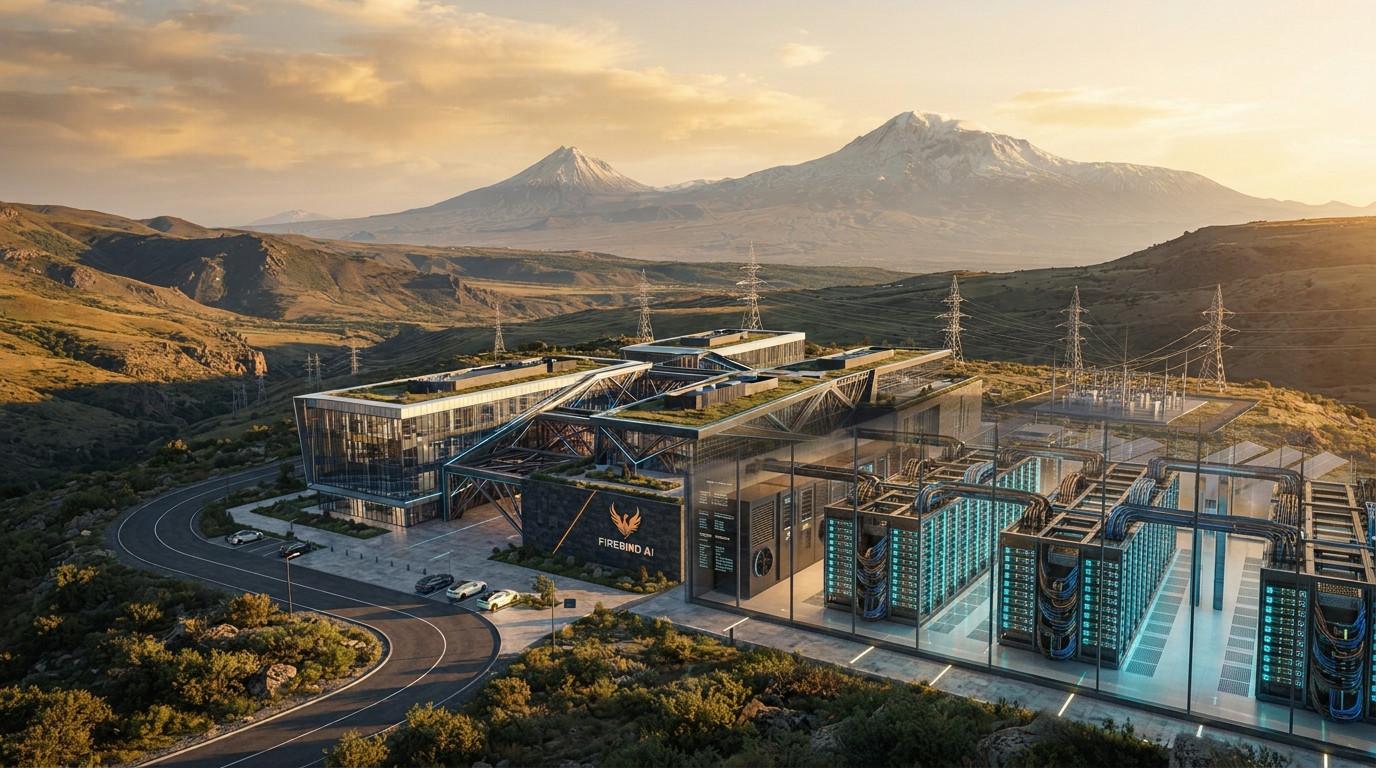
Power, Chips, and Politics: Inside Armenia’s Big Bet on AI
By David Zartarian
For over a decade, Armenia’s tech industry ran on software outsourcing. It was a simple, brain-powered business that needed little more than laptops, fast internet, and skilled engineers. Today, that model is changing fast. By building a massive data center in the mountains north of Yerevan, Armenia is trying to jump from a regional IT hub to a major global center for AI hardware.
This goal comes with steep physical and political costs. Here is a look at how Armenia landed on the global AI map—from the U.S. chip deals that made it possible to the vision shared by Prime Minister Nikol Pashinyan and NVIDIA leaders at DigiTec 2026. It also covers the severe power and water shortages that could stall the boom, how AI is reshaping local tech jobs, and why the massive need for electricity has pushed Armenia toward a once-unthinkable move: connecting its power grid with longtime rivals Turkey and Azerbaijan.
From Software Outsourcing to "AI Factories"
The centerpiece of Armenia’s new tech push is rising in Hrazdan, a former industrial town about 28 miles northeast of Yerevan and roughly thirty miles from the Azerbaijani border. There, Firebird AI—a San Francisco startup founded by diaspora entrepreneurs Razmig Hovaghimian and Alexander Yesayan and backed by Moderna co-founder Noubar Afeyan—is building what leaders call the region’s first large-scale AI supercomputing hub.
First announced in mid-2025 as a US$500 million AI project with NVIDIA, Team Group, and the Armenian government, the plan has grown fast. In February 2026, Firebird and the U.S. government kicked off Phase 2 with a $4 billion investment boost. Then, at DigiTec 2026 in November, Firebird co-founder Alexander Yesayan shared plans to expand the site's power capacity to over 300 megawatts (MW) by the end of 2027, with long-term goals reaching 400 MW. Packed with tens of thousands of advanced NVIDIA chips, the center is built to make Armenia a top global hub for AI computing power.
As highlighted at the recent DigiTec 2026 forum in Yerevan, building a world-class AI hub requires robust physical infrastructure alongside human talent. While these "AI factories" are positioned as a core economic driver—earmarking 20% of capacity for domestic research and 80% for international clients—they depend heavily on sensitive U.S. semiconductors. Washington approved the export of advanced NVIDIA hardware to Armenia following memoranda of understanding signed at the White House in August 2025 between Prime Minister Pashinyan and U.S. President Donald Trump, a move that introduces complex security dependencies given Armenia's historic ties to Moscow and reliance on Russian energy.
The DigiTec 2026 Vision: "From Vision to Action"
During a flagship fireside chat at DigiTec 2026 titled "Armenia's Opportunities in the Field of Artificial Intelligence: From Vision to Action", Prime Minister Pashinyan and NVIDIA Vice President Rev Lebaredian framed the moment as a rare historical equalizer for a small, landlocked nation.
"Armenia could emerge on the global stage in artificial intelligence. Building infrastructure in this field is new for every country," Lebaredian told the audience at Yerevan’s Meridian Expo Center. "You could say all countries are on an equal footing".
Lebaredian cautioned that Armenia’s advantage is temporary and depends on rapidly scaling its power supply before competitors catch up, noting to Euronews that "the more energy you have, the more AI you can produce". Pashinyan added that incoming data centers have sharply reversed the country's energy surplus within months, shifting the nation from a power exporter to hunting for external electricity supplies to feed the Firebird project.
Geopolitics of the Grid: Connecting with Turkey and Azerbaijan
To bridge this looming deficit, Pashinyan announced plans to integrate Armenia’s electricity network with Turkey and Azerbaijan, tying the move to his "Crossroads of Peace" initiative and regional energy transit. According to a press release from the Prime Minister's Office, he called the cross-border integration an "incredible transformation", though critics warn that relying on historic adversaries for power introduces severe security and leverage risks.
Meanwhile, Russian commentators have seized on the U.S.-backed facility as a geopolitical flashpoint. In September 2026, Armenia’s Ministry of High-Tech Industry publicly dismissed claims aired on Russian television alleging that the Hrazdan data center could be used to serve U.S. intelligence interests.
The Solar Bottleneck Meets AI’s Power Hunger
Armenia’s sudden pivot to importing power underscores a striking paradox in its domestic energy sector. As Hetq reported in July 2026 on Armenia’s growing solar energy surplus, rapid solar expansion has left the country generating more daytime electricity than its aging grid can consume—forcing authorities to curtail generation until large-scale battery storage, higher domestic consumption, and new export markets are established.
While hyperscale AI facilities provide massive new domestic consumption, matching intermittent midday solar power with a data center’s relentless 24/7 baseload demand remains a formidable engineering hurdle. In October 2026, the Public Services Regulatory Commission (PSRC) convened technical meetings with Firebird AI and the Electric Power System Operator to map a grid integration strategy for the Hrazdan center, warning that scaling toward 300 MW by late 2027—and eventually 400 MW—could consume upwards of 35% of Armenia’s total electricity supply.
Environmental, Water, and Transparency Concerns
Beyond grid strain, environmental researchers have raised alarms over water consumption and regulatory oversight. An investigation by EVN Report highlighted transparency gaps after Firebird’s Environmental Impact Assessment was submitted and abruptly withdrawn in June 2026, shortly before the facility’s August launch. While project backers emphasize closed-loop cooling systems designed to minimize water loss, Lebaredian acknowledged at DigiTec that scaling AI infrastructure forces unavoidable trade-offs between water, electricity, and cost.
Labor Disruption and the "Digital Extractivism" Warning
On the economic front, Pashinyan sought to ease public concerns at DigiTec 2026, arguing that AI will augment human labor rather than replace it and that tax revenues from the sector will fund public services. At the same time, government ministries have pointed to initiatives like Firebird Labs’ national education partnerships—launched to incubate local ventures in robotics, aerospace, and life sciences—as proof that the project will nurture homegrown talent.
Under its agreement with the Armenian government, Firebird has pledged up to 20% of the Hrazdan facility’s computing capacity for Armenia’s domestic ecosystem, while selling the remaining 80% to international clients. According to the company and the Ministry of Education, that domestic share is designated for local startups—particularly through the Firebird Labs incubator targeting ventures in robotics, aerospace, and life sciences—as well as Armenian universities, public-sector digitalization, and a nationwide educational initiative with OpenAI aimed at reaching roughly 50,000 students.
However, local analysts note that key details remain unclear, including how much of that capacity will be subsidized versus sold at commercial rates, and whether Armenia currently has enough advanced AI researchers to fully utilize it.
More broadly, local civil society researchers and tech analysts warn of a "digital extractivism" model in which Armenia supplies land, water, and scarce electricity to power foreign AI workloads while capturing minimal long-term intellectual property. Because hyperscale data centers require relatively few permanent technicians once built—and because generative AI is already shrinking entry-level software outsourcing jobs across Yerevan—critics argue that Armenia risks trading away vital natural resources without solving its chronic shortage of local PhD-level AI researchers.
Sovereignty or Server Landlord?
Ultimately, Armenia’s high-stakes gamble on artificial intelligence is a test of whether a small, landlocked nation can turn massive physical infrastructure into genuine technological sovereignty.
While the arrival of U.S. microchips and multibillion-dollar data centers offers a rare chance to reshape the economy, the true cost will be measured not in megawatts or server racks, but in how Yerevan manages its strained water reserves, fragile power grid, and delicate geopolitical dependencies. Without transparent environmental oversight, deep investments in homegrown research, and a clear strategy to protect its domestic workforce, Armenia risks trading away its scarcest natural resources only to become an energy-hungry landlord for foreign computing demands—rather than an architect of its own digital future.
(David Zartarian is a writer and commentator focusing on energy infrastructure, technology, and South Caucasus politics.)
Editorial illustration depicting Armenia's AI infrastructure ambitions. (AI-generated image)
Write a comment