 Videos
 Photos


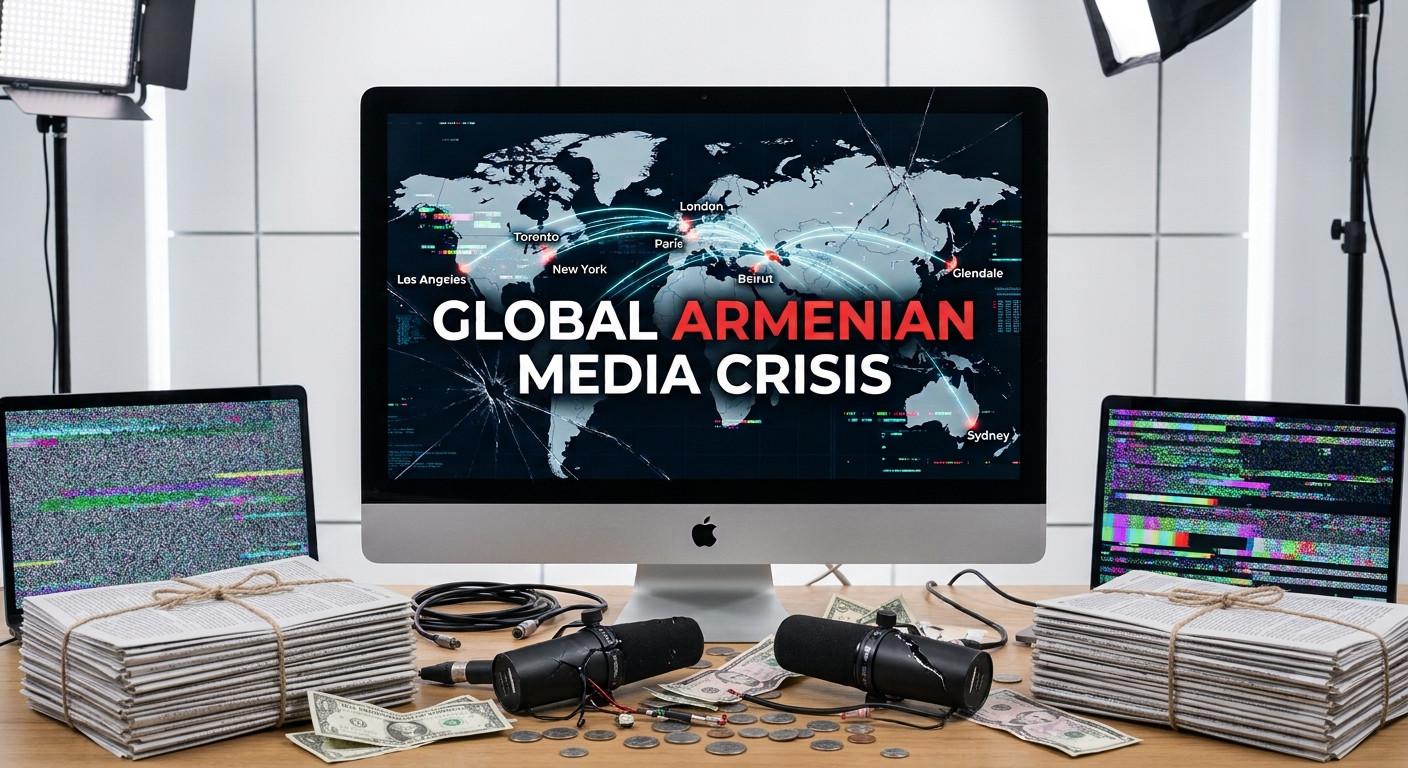
The Fragile Network: Inside the Global Armenian Media Crisis
By John Takoushian
In the crucible of existential threat, a nation requires a press corps that acts as a clear lens, a fearless investigator, and a bridge. Yet the Armenian media landscape—both within the Republic of Armenia and across its vast global diaspora—remains structurally broken, chronically underfunded, and intellectually isolated. Confronted by aggressive regional adversaries and profound geopolitical shifts, the current state of Armenian journalism is not just an institutional failure; it is a national security vulnerability.
The 2020 Artsakh War and the Breakdown of Verification
The most devastating symptom of this dysfunction is the complete erosion of journalistic fundamentals and editorial oversight, a crisis laid bare during the catastrophic 2020 Artsakh War. The truth is that the media in Armenia was woefully unprepared to cover the 2020 war. For forty-four days, mainstream media platforms in Armenia and the diaspora largely abandoned the core tenet of journalism: verification. Instead, they functioned as an echo chamber for official state rhetoric, leaning into a heavily managed "national" narrative that unquestioningly repeated the Ministry of Defense’s daily mantra that victory was imminent (“Haghtelu enq ‘ – We will win).
Editors failed to cross-reference official claims with battlefield realities, blinding the public to the imminent catastrophe. This nationalistic filter was so pervasive and devoid of objective facts that non-Armenians, as well as critical observers, mainly turned to foreign reportage to learn anything accurate about the progression of the war. When the trilateral ceasefire agreement was signed, the sudden pivot from triumph to total defeat shattered public trust. By prioritizing state-sanctioned morale over objective truth, the press failed to hold power to account when scrutiny was needed most.
Soon after the Armenian military defeat, I remember the editor of one well-known online media outlet in Armenia charging the Pashinyan administration of “duping him” about the 2020 war. Was this supposed seasoned journalist so naïve to believe that the government would refrain from misleading the public as to the war effort? All governments are known to “play with the facts” and this editor like many in Armenia failed to understand this. Yes, the Armenian government placed restrictions on what the media could report about the war, but editors conveniently towed the official line and have never apologized to their readers for doing so. They could have better served their readers by not publishing, practically verbatim, what the government and its public relations agencies were dishing out.
Financial Starvation and Post-Soviet Inheritances
This lack of professionalism is directly tied to the starvation of resources and a deep-seated provincialism. Genuine independent journalism requires sustainable capital, yet independent media outlets in Armenia are severely underfunded. Without robust institutional backing or a culture of reader subscriptions, domestic media routinely falls prey to political polarization, often subsidized by competing oligarchic factions or political parties who view newsrooms as public relations wings.
Most of the “independent” news sites in Armenia receive much needed funding from a variety of foreign sources – governments, international donor organizations, etc. Only a small percentage of their working budgets is derived from advertising revenue or reader subscriptions. What impact this has on their objectivity is hard to gauge but they must explore new ways to sustain their existence. News outlets in the diaspora face similar challenges, relying on small staffs supported by volunteers.
Compounding this financial crisis is a severe isolation from international journalistic standards. Armenian reporters suffer from a profound lack of exposure to the global media landscape, resulting in an environment where news and feature stories are structurally flawed. Because local journalists have historically had little access to international newsrooms, fellowship programs, or global media training, they lack a blueprint for objective, multi-sourced reporting. Instead, their only structural examples are local media outlets or state-influenced Russian sources. Consequently, Armenian news stories are frequently structured around passive transcription rather than active investigation, mirroring the top-down, commentary-heavy, and state-centric narrative styles prevalent in the post-Soviet sphere.
One troubling sign of these low professional standards is the routine violation of copyright laws. News sites in Armenia that produce original reporting often must go to court to stop competitors from copying and republishing entire articles word for word, directly violating their "Terms of Use." Many outlets lack the staff to generate their own stories, so they steal from others to fill their pages. Unfortunately, this also happens in the diaspora, where solo operators routinely pick and choose content from established news organizations without permission or even live links to the original content. Such irresponsible behavior merely degrades the journalism, requiring time and money, created by others.
The Long-Form Deficit and the Language Barrier
This training deficiency manifests heavily in long-form journalism: reporters in Armenia still struggle to draft engrossing feature stories, relying more on dry data, official declarations, and numbers rather than weaving an interesting, human-centric narrative that engages the reader. Rather than leading with a rigorous, fact-driven inverted pyramid or crafting deeply reported profile pieces, stories often devolve into opinionated editorials or uncritical summaries of official press releases.
Meanwhile, the wealthy Armenian diaspora has failed to build the very infrastructure needed to sustain its global identity and elevate local standards. There is an absolute absence of a unified, professional media platform capable of connecting disparate Armenian communities—from Glendale and Buenos Aires to Paris and Beirut. Critically, Armenians in the diaspora have few places to source news from Armenia in English. This is primarily because domestic outlets lack the funding to maintain professional English-language translation desks, while diaspora-based organizations remain hyper-focused on localized community bulletins rather than investing in professional, real-time English reportage from the homeland. This language barrier severely dilutes the diaspora's ability to stay accurately informed, forcing second- and third-generation Armenians to rely on sporadic, filtered, or delayed updates.
Selective Silence: Diasporan Media’s Refusal to Confront Community Corruption
The Armenian press, both in Armenia and the diaspora, failed to cover a major March 2022 Los Angeles Times investigation exposing how millions of dollars in Armenian Genocide settlement funds were stolen by corrupt lawyers and organizations. While Armenian outlets eagerly celebrated the initial $37.5 million court victories years earlier, they maintained a "baffling silence" once it was revealed that many of the culprits were Armenians who defrauded rightful victims.
Beyond the fact that the story "hit too close to home" and portrayed community members negatively, the Armenian press as an institution in the diaspora is ill-equipped for deep investigative journalism—favoring profitable infotainment over traditional muckraking, even on issues directly affecting its audience.
Consequently, Armenian media and establishment groups selectively ignored the scandal, even after the LA Times translated the report into Armenian and California officials launched investigations.
The Missing Link: The Isolation of Russia's Armenians
This systemic blind spot is nowhere more evident than in the collective ignorance surrounding the Armenian community in Russia. Despite being home to one of the largest, wealthiest, and most geopolitically significant Armenian populations in the world, virtually nothing is known about their internal dynamics, struggles, or perspectives within Western diaspora circles or mainstream Armenian society. The lack of a transnational media bridge has left this massive segment of the nation completely siloed, cut off by language barriers, political sensitivities, and a lack of investigative curiosity from global Armenian outlets.
In the vacuum left by the decline of traditional press, social media has weaponized public discourse. In Armenia, Telegram channels, Facebook live-streams, and TikTok algorithms have largely eclipsed traditional newspapers and broadcasters as primary news sources. While social media offers an alternative to state-influenced television, it operates completely devoid of editorial oversight. It has become a breeding ground for unverified rumors, polarization, and foreign disinformation campaigns. Rather than informing the citizenry, the digital landscape has deepened tribal divisions, leaving the public vulnerable to manipulation.
A New Vanguard Emerges
For the Armenian world to navigate its complex future, the media landscape requires a radical restructuring. The diaspora must pivot its philanthropic focus away from purely symbolic projects and toward funding rigorous, independent, and investigative journalism. Armenian media must actively break out of its post-Soviet shell, exposing its reporters to global practices, establishing professional networks that transcend borders, integrating the Russian-Armenian reality, and restoring rigid editorial standards. Until the Armenian press reclaims its role as an independent watchdog rather than a political megaphone or an emotional balm, the nation will remain uniquely unprepared for the challenges of tomorrow.
Yet, amid these profound structural challenges, the foundations of the Armenian media landscape are slowly shifting, offering a cautious but tangible blueprint for a better future. The collective trauma of recent history has catalyzed a quiet reformation.
A new vanguard of young, digitally native Armenian journalists is pushing past the boundaries of the post-Soviet mold. Armed with foreign language skills and an eagerness to learn, they are increasingly seeking out international fellowship programs, collaborating with global investigative networks, and adopting contemporary narrative techniques. This has led to a burgeoning landscape of niche, independent outlets that reject the sensationalist, data-heavy transcripts of the past in favor of beautifully woven, multi-sourced human-interest features and rigorous fact-checking initiatives.
Top visual AI generated
(John Takoushian is a writer and observer of Armenian affairs whose commentary focuses on media literacy, national resilience, and diaspora engagement. He explores the evolving relationship between the Republic of Armenia and Armenian communities across the globe.)
Write a comment