 Videos
 Photos


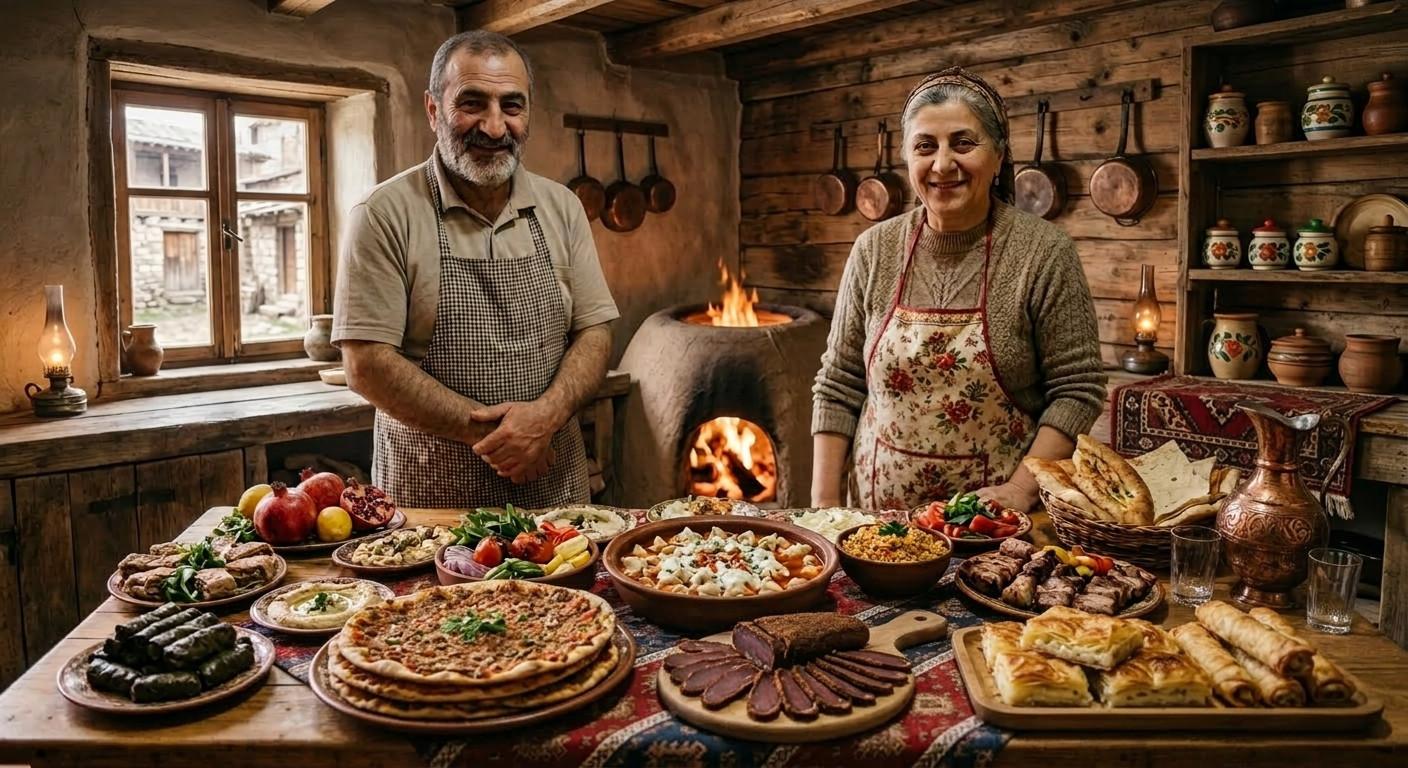
A Tale of Two Hearths: How History Severed and Shaped the Armenian Palate
By Baghdo Tokatlian
When diaspora Armenians visit the Republic of Armenia for the first time, they often experience an unexpected cultural shock at the dinner table. The travelers search menus for the familiar, heavily spiced lamb shish kebab and earthy bulgur pilafs of their childhoods, only to find locals feasting on massive slabs of bone-in pork paired with a mysterious grain shift to white rice.
This culinary disconnect is the result of a century-long historical divergence. Armenian cuisine is fundamentally split into two distinct traditions: Western (Ottoman) Armenian and Eastern (Caucasus/Soviet) Armenian. While the Eastern variant was forged in a landlocked, heavily centralized environment, Western Armenian food developed across a massive imperial trade network—making it one of the most varied, cosmopolitan, and complex cuisines of the old world.
The Imperial Crucible: Why Western Means "Ottoman"
To understand the sheer variety of Western Armenian cuisine, one must realize that it is, at its heart, Ottoman-Armenian cuisine. Historically, "Western Armenia" encompassed a vast territorial expanse stretching from the mountainous Anatolian highlands down to the coastal Mediterranean kingdom of Cilicia.
Because Armenians were deeply woven into the urban, commercial, and economic fabric of the Ottoman Empire—frequently serving as imperial palace chefs, international merchants, and cosmopolitan citizens—their cooking evolved hand-in-hand with the imperial palate.
This vast geography created distinct regional sub-cuisines:
- The Anatolian Highlands (e.g., Erzurum, Van): Focused heavily on cold-weather dairy, grains, and hearty slow-cooked meats.
- The Coastal & Southern Cities (e.g., Aintab, Marash, Adana, Diyarbekir): Directly bordered the Levant or key trade networks, integrating olive oil, abundant fresh herbs, citrus, nuts, and complex spices.
Furthermore, Western Armenian chefs had front-row access to the global spice trade. They integrated warm aromatics like allspice, cinnamon, cumin, and mahleb into savory meats and complex pastries. Conversely, Eastern Armenian cuisine developed in a more condensed geographic footprint across the South Caucasus, leaning away from heavy spice profiles to highlight the simple, unadorned flavors of high-quality meats, fresh wild mountain greens, and simple stone-oven baking (tonir).
The Grain Shift: The Sovereignty of Bulghur
A common misconception is that rice was entirely absent from the old empire. Rice was an urban luxury and status symbol. In major Ottoman hubs like Constantinople or Smyrna, wealthy Armenians regularly cooked rice pilaf or stuffed it into high-end dolma. However, for the millions of rural Armenians living in the provinces, wheat was the absolute king of the soil. Families processed wheat at home into various grades of bulghur (parboiled, cracked wheat). Bulghur pilaf and eetch (bulghur salad) formed the daily baseline of Western Armenian nutrition.
When survivors of the 1915 Genocide migrated to the United States or Europe, they didn't experience a Levantine fusion—the Levantine-adjacent flavors were already native to those from Southern Anatolia. Instead, they experienced an American-market fusion of necessity.
Finding zero bulgur on mid-century American grocery shelves, immigrants took their traditional village technique—browning fine vermicelli noodles in massive amounts of butter and cooking it in rich chicken broth—and applied it directly to cheap American white rice. This hybrid creation became the ubiquitous Armenian-American Rice Pilaf, a dish so wildly successful it eventually inspired commercial products like Rice-A-Roni.
Charcuterie, Lamination, and the Mastery of Preservation
A defining feature of the Western Armenian kitchen was its absolute mastery of charcuterie and highly technical pastry arts—sectors born from urban commerce and long preservation needs. Western Armenians excelled exceptionally at creating complex cured meats and multi-layered baked goods:
- Basturma & Soujouk: Originating heavily from historical Armenian livestock hubs like Kayseri (Gesaria), these air-dried, highly seasoned delicacies were preserved to survive the harsh Anatolian elements. Basturma is highly prized for its thick, aromatic coating of chemen (a paste of fenugreek, hot pepper, and crushed garlic), while soujouk is a dry, heavily spiced minced beef sausage.
- The Pastry Arts (Pakhlava & Laminated Dough): Western communities mastered multi-layered, syrup-soaked desserts like pakhlava and bourma, building upon fine, paper-thin phyllo sheets brushed with clarified butter.
- The "Kata" vs. "Gata" Paradox: Nothing illustrates the regional divide better than this pastry. In the Republic of Armenia today, Gata is universally known as a round, dense, almost bread- or cake-like structure baked in a tonir or oven. However, for Western Armenians—especially those originating from the Kayseri region—traditional Kata (or Kete) is an entirely different beast. It is an incredibly light, flaky, and laminated pastry. To achieve this, enriched yeast dough is rolled out into massive sheets using a specialized rolling dowel (okhlavoo), heavily smeared with butter, folded repeatedly like a croissant to form distinct layers, and filled with a toasted flour-and-butter mixture called khoriz.
- The Beorek Family (Meat, Cheese, and "Sou"): Western cooking elevated the layered pastry art of the beorek (börek) to supreme levels. From Kayseri came individual handheld triangles stuffed with gheyma (a highly seasoned ground beef mixture with onions and parsley) or salty cheese mixtures blended with fresh herbs. The ultimate test of an Armenian home cook’s skill, however, was Sou Beorek (water borek). This lasagna-style architectural marvel requires rolling large sheets of dough paper-thin, briefly boiling each individual layer in a large pan of water, shocking them in cold water, and layering them meticulously into a baking pan drenched in clarified butter and packed with a blend of cheeses (often Bulgarian feta or kasar) and parsley. The result is an incredibly melt-in-your-mouth, pillowy, multi-textured masterpiece.
In modern Yerevan, true pakhlava, authentic basturma, and laminated kata remain surprisingly hard to find. The commercially mass-produced versions sold across present-day Armenia are often far removed from the artisanal originals, leaning into thick, heavy Soviet baking techniques or simplified curing processes that strip away the complex aromatic spice profiles.
From Grazing Sheep to Soviet Swine
The starkest contrast between the two cuisines lies in the meat. For Ottoman Armenians, lamb and mutton were the definitive, primary proteins. The Anatolian landscape was perfectly suited for grazing sheep, and living inside a Muslim-majority empire meant the commercial meat market naturally revolved around lamb and beef.
The preference in the modern Republic of Armenia today is entirely different: pork is the undisputed king of the grill. This pivot was a direct byproduct of Soviet industrialization. When Eastern Armenia was absorbed into the USSR, the state centralized agriculture and built massive, industrial swine-breeding farms. Pigs mature rapidly and reproduce efficiently, making them the perfect economic engine for feeding a Soviet populace. Over generations, pork became deeply normalized, entirely free from the religious taboos that kept it off Western Armenian tables in the Middle East.
This divide even altered the vocabulary of fire:
- The "Shish Kebab" Illusion: In the diaspora, shish kebab means neatly trimmed cubes of boneless lamb or beef skewered alongside peppers and onions.
- The Reality of Khorovats: In the Republic of Armenia, the term "shish kebab" is virtually unknown. Grilling meat over wood coals is called khorovats. Furthermore, if you order a kyabab in Yerevan, you will receive seasoned ground meat molded into a tube around a skewer (what Western Armenians call losh or luleh kebab). Republic-style khorovats uses massive, heavy, bone-in cuts of pork, and the vegetables are always roasted on entirely separate skewers.
The Pillar of the West: Traditional Western Armenian Dishes
The hallmark of Western Armenian cuisine is its intricate assembly, heavy reliance on cracked wheat grains, and complex, sweet-and-savory flavor profiles heavily scented with warm spices:
- Manti: Tiny, boat-shaped baked dough pockets packed with seasoned ground beef or lamb. They are roasted until golden brown, then simmered in hot tomato broth and served with a heavy dollop of garlic-infused yogurt and a dusting of sumac.
- Kharpert Kufteh: A triumph of culinary technique. This dish features a smooth outer shell made of thoroughly pounded lean meat kneaded with fine bulgur, which is then stuffed with a rich, spiced mixture of ground meat, fried onions, and pine nuts. The resulting spheres are poached in a seasoned broth.
- Lahmajun (Armenian Meat Pies): Borrowing its blueprint from the Arabic laḥm bi-ʿajīn, this hybrid regional merging features an impossibly paper-thin, crisp, wood-fired crust. It is smeared with a finely minced, garlic-forward topping of ground lamb or beef, tomato paste, bell peppers, fresh parsley, and sometimes sweet pomegranate molasses.
- Eetch: A robust salad or side dish consisting of fine bulgur cooked with sautéed onions, heavy tomato and pepper pastes, olive oil, lemon juice, and a vibrant garden of fresh parsley and green onions.
- Choreg: A sweet, aromatic brioche-style braided bread made with milk, plenty of butter, and a heavy hand of mahleb—a powder ground from sour cherry stones that gives the pastry its uniquely fragrant, nutty flavor profile.
The Soul of the East: Traditional Eastern Armenian Dishes
Thriving on a deep connection to its mountain terroir, long simmering stews, and Soviet or Persian cross-pollinations, the Eastern Armenian table highlights natural proteins and fresh, unadorned flavors:
- Khash: A thick, unseasoned winter broth made by slow-simmering cow’s hooves overnight. Eaten strictly at dawn, it is consumed as a communal ritual where diners customize their bowls with crushed garlic, a mountain of dried lavash breadcrumbs, and shots of local fruit vodka (oghi).
- Spas: A comforting, velvety yogurt soup made from fermented matzoon mixed with hulled wheat berries (dzavar). Flavored with fresh mint or cilantro, it is enjoyed piping hot in winter or chilled during the summer.
- Zhingyalov Hats: An iconic, masterfully folded flatbread native to the Artsakh region. The unleavened dough is rolled paper-thin and stuffed with a precise mix of 10 to 20 varieties of wild, finely chopped mountain greens and fresh herbs before being dry-seared on a griddle.
- Khashlama: A rustic, slow-steamed celebratory stew where large, bone-in chunks of beef or lamb are layered in a deep pot with bell peppers, sliced onions, tomatoes, and fresh herbs, then simmered for hours—often with a splash of beer or wine—until the meat slips off the bone.
- Tzhvzhik: A quick, heavily savory fry of beef or lamb offal (liver, lungs, and heart) tossed with a massive mountain of sliced sweet onions, fresh tomatoes, and mild seasonings.
Documenting a Culinary Legacy: The Literature and Digital Archives
Because of centuries of geopolitical fragmentation, displacement, and the oral nature of kitchen traditions, much of Armenia's food history was preserved on stained index cards rather than in state archives. However, a rich body of published material and interactive digital documentation brilliantly bridges the gap between historical narrative, folklore, and recipe preservation:
- Houshamadyan (Cuisine Project): This monumental, non-profit digital initiative performs a localized, geographic reconstruction of Armenian life across Ottoman towns and villages. Rather than viewing Western Armenian food as a monolith, Houshamadyan hosts localized culinary studies. It maps out highly specific, sub-regional foodways, highlighting how the circular dried lavash of Van hung in sacks from the ceiling, the unique usage of local mulberries to replace sugar in Agn, or the deep, heavily spiced meat and koufta traditions of the ancient trade hub of Diyarbekir. It is an invaluable living map of historical recipes that vanished from the geography but survived in the diaspora.
- Armenian Food: Fact, Fiction & Folklore by Irina Petrosian and David Underwood. This is arguably the closest thing to a standalone cultural textbook. It explores the physical journey of the land, examining everything from ancient fables to the sweeping architectural changes forced upon the kitchen by the Soviet Union.
- Home Again: Armenian Recipes from the Ottoman Empire by Mari Firkatian. A masterful piece of cultural preservation, Firkatian spent over a decade interviewing descendants of Genocide survivors, capturing the authentic blueprint of lost village recipes from the old provinces.
- Treasured Armenian Recipes: First published by the AGBU in 1949, it features hundreds of traditional Armenian dishes spanning appetizers to desserts from the “Old Country”.
- Lavash by Kate Leahy, John Lee, and Ara Zada. This photo-journal and cookbook functions as a modern historical look at how food is prepared today across the Republic of Armenia, charting the endurance of ancient clay-pot cooking and open-flame baking.
The Modern Frontier: Repatriates Reclaiming the Kitchen
Today, the culinary border is rapidly dissolving—but this unification is happening strictly within the borders of present-day Armenia, not in the diaspora. In cities like Los Angeles, Beirut, or Paris, the decades-old separation remains clean, with diaspora communities keeping their inherited Ottoman-Armenian culinary styles separate from post-Soviet Eastern arrivals.
However, in the streets of Yerevan, a major culinary renaissance is unfolding. Because mass-commercial operations in Armenia struggle to capture the complex, labor-intensive techniques required for authentic Western fare, it is the repatriates—both old and new—who are doing a far superior job at preparing these ancestral foods.
Nowhere is this stark qualitative difference clearer than in the history of lahmajun (Armenian meat pies) in the capital.
For decades under Soviet and early post-Soviet rule, the local version of lahmajun sold in Yerevan was notoriously unauthentic—frequently rendered as a bland, soupy, watery meat mixture poured over a thick, soggy piece of dough. It completely lacked the signature crisp and aromatic complexity of the original dish.
That reality changed entirely with the influx of Syrian-Armenian repatriates fleeing the civil war in the 2010s. Setting up small, specialized bakeries across Yerevan, these artisans introduced the city to authentic lahmajun: a paper-thin, incredibly crisp, wood-fired crust topped with a highly concentrated, perfectly spiced blend of minced lamb or beef, pomegranate molasses, tomato paste, bell peppers, and fresh herbs.
Waves of Syrian- and Lebanese-Armenian repatriates, along with dedicated diaspora culinary artisans returning home, have flooded the capital with these highly specialized spice shops, true bulgur variations, Aleppo-style kebab houses, and bakeries turning out exceptionally laminated kata and flaky pakhlava.
By rescuing these techniques from historical oblivion and planting them firmly back into the soil of Yerevan, these repatriates are doing more than just serving dinner—they are stitching a fractured national identity back together, one layer of pastry at a time.
(Bagdo Tokatlian, a lover of simple, tasty food, continues his search for the ultimate Sou Boerek and Kharpert Kufteh.)
Top photo AI generated
Write a comment