 Videos
 Photos


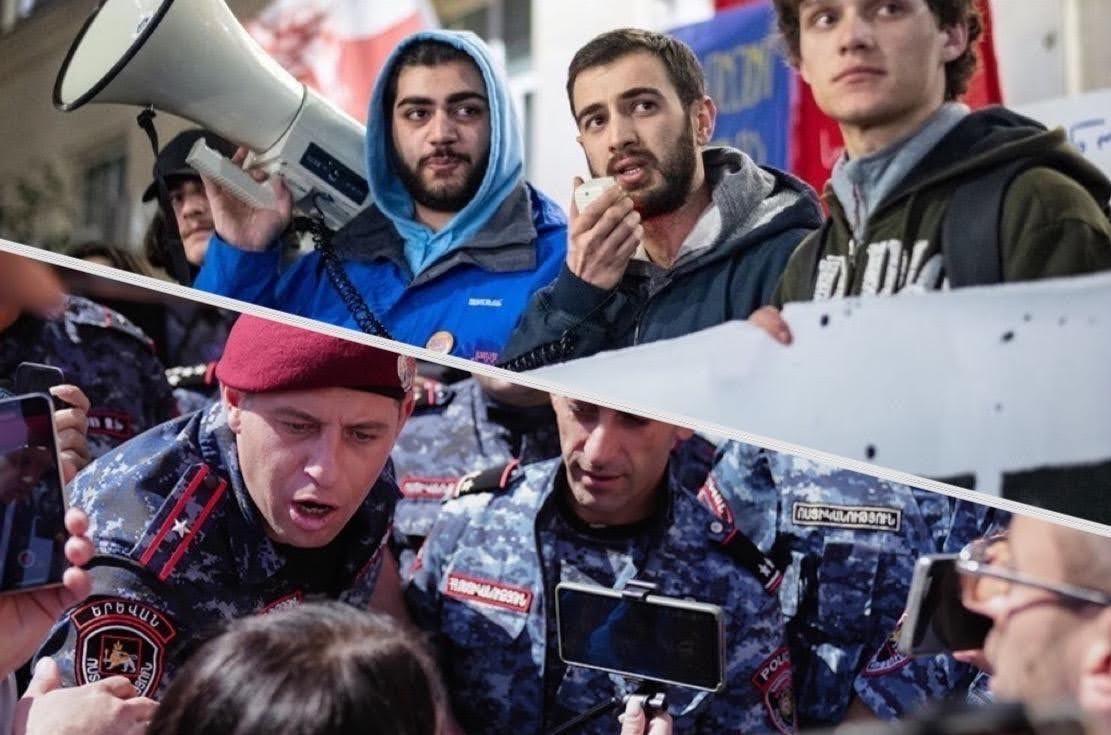
Silencing Dissent: Government Interference Threatens Academic Freedom in Armenia and Georgia
By Anton Geissler (Hetq intern)
Prof. Mariam Gesamia, a media and education specialist at Tbilisi State University (TSU) and the founder of Media Voice, tells Hetq that our conversation about academic freedom could be punishable under Georgian law.
The Foreign Agents Registration Act, adopted in April 2025. could potentially label her as a “foreign agent” for exchanging information with a “foreign principle” such as Hetq. Not registering as a foreign agent carries legal penalties of up to five years in prison.
The Academic Freedom Index of Georgia has been falling since 2020 from 0.88, a figure comparable to many Western-European countries, to 0.58 in 2025.
Across the border, Armenia follows a similar trend, falling from 0.84, an all-time high in 2019, to 0.58 in 2025.
These are the lowest figures since the Soviet Union’s collapse.
Hetq has interviewed academics and researchers in both countries to discover how and why academic freedom is being eroded in the region.
A Threat to Democracy
Dr. Angelo Panaro, a researcher at Friedrich-Alexander-University (FAU), who works on the Academic Freedom Index project, highlights the connection between democracy and academic freedom. He tells Hetq how a decline in academic freedom often correlates with the decline of democracy.
In Georgia, this connection is further explained by Dr. Tamar Tatanashvili, a researcher at the Max Planck Institute and former lecturer at Tbilisi State University. She tells Hetq that the Georgian government is intentionally targeting universities, viewing the highly active student body as a direct threat to its power.
Higher education, as one of the biggest public spheres in Armenia, can be an important platform of both dissent and control, Serob Khachatryan, a philosophy professor at Yerevan State University (YSU) and the author of an EU report on Higher Education in Armenia, tells Hetq.
Academics lack protection
Dr. Tatanashvili was sacked alongside her colleague in March 2025 from the Tbilisi State University’s Faculty of Law for her pro-democracy views. She believes that her dismissal was the direct result of her protest against the “Foreign Agent Laws.” After eight years of teaching, she was let go without an official explanation.
In Armenia, another high-profile case was the dismissal of Genocide Museum Director Edita Gzoyan in March 2026. She was asked to resign by PM Nikol Pashinyan after giving a book about the Nagorno-Karabakh conflict to U.S. Vice President JD Vance.
Prof. Menua Soghomonyan tells Hetq about political dismissals at Armenian universities. In July 2024, his contract as a lecturer at Yerevan State University’s Political Science Department was not renewed, together with one other colleague, due to their political views.
Prof. Soghomonyan is a member of the HayaQve (Armenian Vote) National Civic Movement. He believes that the government should have stepped down after the 2020 Nagorno-Karabakh War defeat and criticises the government for its policy on Artsakh and for “establishing consolidated authoritarianism in the country.
No reason was provided for the termination of Prof. Soghomonyan’s contract. In May 2024, his head of department had complained that he was turning lectures into political propaganda, but Prof. Soghomonyan tells Hetq that he has “neither the need nor the time to share his political views with students.” He also describes how pro-government lecturers who share their political preferences in the classroom do not face any issues.
“There have not been prosecutions of this kind since the times of Stalinist terror,” Prof. Soghomonyan says, citing five other lecturers at Yerevan State University who were fired this summer for their anti-government positions.
In September 2026, Prof. Soghomonyan won a court case against the university, which was ordered to pay him millions in compensation for the unlawful decision to dismiss him.
De jure protections against arbitrary dismissal do exist under Armenian labour laws, but the university bypasses these rules through procedural manipulations.
Before the termination of Prof. Soghomonyan’s contract he taught three courses at YSU’s Department of Political Science. These were either cancelled, moved to another department, or moved from the third semester to the sixth semester. These changes were not discussed in department or faculty meetings despite the faculty charter requiring deliberation in both bodies. “Every possible measure was taken to ensure that I was left with zero teaching workload,” he says.
Employment contracts at YSU also make academics vulnerable to dismissal. Prof. Soghomonyan was employed through the annual renewal of his contract, allowing the university to let him go after losing his teaching workload.
Prof. Khachatryan believes that the lack of an established system of tenure makes academics especially vulnerable to political pressure. At YSU, lecturers are either employed through competitive appointment or on an annual contract. However, Prof. Soghomonyan tells Hetq that no competitive selection processes have been held at the Department of Political Science since 2019.
In Georgia, the situation is similar. Dr. Tatanashvili tells Hetq how most lecturers at Tbilisi State University’s Faculty of Law are employed on a semester by semester invited basis, to “artificially avoid competitive hiring.”
Armenia and Georgia: A Comparison
While Dr. Panaro argues that both counties (Georgia and Armenia) have de jure protections of academic freedom, including articles in their constitutions, he describes how academics are limited by the fear of repercussions such as losing their jobs.
Dr. Tatanashvili tells Hetq that the termination of her contract was a “direct signal and intimidation mechanism for the remaining staff.”
The repressive mechanism is felt by her colleagues at TSU. Prof. Gersamia tells Hetq that intimidation is widespread.
“Somewhere, there is a fear that if I do that or if I say that, that might influence my career, my life, my safety and so on.” She and her colleagues plan what to do in the event of being arrested and risk losing their job if they express their opinions. “There is a signal that, okay, if I do something wrong, then I will be punished.”
Prof. Valerian Dolidze, at the TSU’s Department of Political Science, agrees with Gesamia’s description. “There is a fear that if you express yourself freely, you might get hurt.”
Across the border, in Armenia, Prof. Khachatryan tells Hetq how “most professors are very careful. They don't talk openly.”
The culture of self-censorship is a legacy of the Soviet era in both countries. Prof. Khachatryan believes that Armenians were trained to live a double life during the Soviet Union, only privately expressing discontent.
When Prof. Soghomonyan was fired, only four lecturers from YSU’s Department of Political Science expressed support. “The rest remained silent.”
In Georgia, academics also limit their activity to what Prof. Gersamia calls “confidential solidarity.” More of her colleagues only express their concerns about the government and sympathy for targeted academics privately.
Dr. Tatanashvili tells Hetq that after her dismissal, most of her colleagues chose public silence and only expressed solidarity in private communications.
Mechanism of Control
Prof. Khachatryan says that academics who criticise the government will be overlooked and excluded from commissions or projects.
In Georgia, Prof. Dolidze further describes how academic competitions are used to dismiss politically unacceptable lecturers and adds that “competitions and reorganizations create internal censorship.”
Dr. Tatanashvili believes that she will never succeed in an academic competition, despite her qualifications. “I have been placed on an informal blacklist.”
The government has also implemented other “legal” mechanisms to erode academic freedom in Georgia.
The Law On Grants subjects foreign funding to prior government approval. Academics face criminal charges for non-compliance.
In addition, through the 2026 amendments to the Law on Higher Education and related legislation, the government has introduced a quota system that allows it to determine how many students are admitted to specific courses. Prof. Dolidze describes these quotas as a “legal instrument to get rid of politically unacceptable faculty members.
The law is framed as an attempt to align higher education with labour market needs, but has allowed the government to cut 92% of students at Ilia State University (ISU), which is known to be a hub of pro-democracy protests.
The amendment also restructures higher education under the “One City- One Faculty” initiative. This change assigns every faculty to only one university and moves many faculties out of Tbilisi, where Georgian Dream the ruling party of Georgia lacks support, to Kutaisi.
Armenia has similar plans to reduce the number of state universities from twenty-three to six under the government’s 2026-31 program and move them out of Yerevan’s city center to an Academic City. Under the May 2026 amendments to the Law on Higher Education and Science the government also decides what courses receive state-funded tuition. Still, the effect of these changes on academic freedom remains to be seen.
In Armenia, institutional autonomy, rather than being targeted through the judiciary system, is endangered through governmental control of university boards.
Infocom revealed that eight of twelve university chairs of boards of trustees in Yerevan were political appointees in 2024. Today the situation is similar.
Armenian President Vahan Khachaturyan serves as Board Chairman of the Armenian University of Economics. Minister of Defense Suren Papikyan is the Board Chairman at Yerevan State University. This board includes Artur Martirosyan, who only recently was dismissed from his position as Deputy Minister of Education, Science, Culture, and Sports, and Mkhitar Hayrapetyan, the previous Minister of High-Tech Industry.
This practice persists despite Article 26 of the 2025 Law “On Higher Education and Science,” which explicitly prohibits government officials and party members from serving on university boards of trustees.
Prof. Soghomonyan tells Hetq more about the process of electing the rector at YSU. Hovhannes Hovhannisyan was re-elected in September 2026 as the sole candidate. He previously held the position of Deputy Minister of Education and Science in 2018 and was a member of the National Assembly for the pro-government My Step alliance from 2019 to 2021. To enable Hovhannisyan to become rector in 2021, Prof. Soghomonyan tells Hetq how the government, without consulting YSU, lowered the qualification requirements from the rank of professor to a Candidate of Sciences degree.
Prof. Soghomonyan believes that this year's election process informally barred other candidates. The competition was announced in mid-August, when the academic community was on holiday and the two-week deadline for submitting documents by August 31, prevented other candidates from preparing.
Prof. Khachatryan points to the problem of institutional autonomy as the reason for the decline of academic freedom in Armenia. He believes that the government is afraid of losing control of universities and paraphrases Thomas Hobbes: “controlling universities is very important for every government.”
Why Now
While academic freedom is in decline across the world, certain trends are specific to both countries.
After the 2018 ‘Velvet Revolution’, academic freedom in Armenia rose as universities generally supported the government. However, Prof. Khachatryan tells Hetq that “things changed after the Karabakh war,” when public opinion and many academics turned against the government.
Dr. Panaro at FAU agrees with this assessment but identifies the outbreak of the Covid-19 pandemic as the initial factor contributing to the decline of academic freedom in Armenia. This decline was subsequently compounded by the Karabakh War, increasing political and social polarisation, and education reforms.
A similar process can be seen in Georgia. After Georgian Dream won the parliamentary election in 2012, academic freedom rose dramatically.
Prof. Dolidze notes that the government again began to openly attack academic freedom after its rating dropped. This is reflected in the data. Academic freedom started to decrease after the 2020 election, which only had 26% participation after the opposition called for a boycott.
Prof. Khachatryan explains that the government’s fear of losing control in Armenia stems from the country’s political culture. Because there is no established culture of exchanging power with the opposition and because governments have slim chances of being re-elected, they need to maintain control for as long as they can.
However, in Georgia, Prof. Gersamia offers a more hopeful picture. “This government does not have the resources for a dictatorship” she tells Hetq, citing the amount of surveillance needed to control all academic activity.
A Different Perspective
In Armenia, other academics share a different perspective with Hetq. Prof. Vardan Voskanyan, Chair of Iranian Studies at YSU tells Hetq that he has “never experienced any sort of limitation on academic freedom, like writing articles and teaching any subject.”
Anna Gevorgyan and Aram Pakhchanian, two education specialists at the American University of Armenia (AUA) agree with Prof. Voskanyan’s statement and contrast it to the situation pre-2018.
Gevorgyan tells Hetq about Ararat Mirzoyan, who cited political reasons for losing his job as a history lecturer at YSU in 2013 and is now Armenia’s Foreign Minister. “I cannot imagine that his government is going to do something like that, given the past that they have had.”
However, Prof. Khachatryan believes that the level of academic freedom is different between state and private universities. AUA wrote a statement about the arrest of pro-Artsakh protestors on their campus in 2023, which gained international attention and is mentioned in the 2023 Scholars at Risk report. However, Khachatryan concludes that “If these things had happened at an Armenian state university, they would not have made a statement.”
Still, most of the academics interviewed by Hetq believe that the situation will get better. Prof. Gersamia and Khachatryan hope for a demographic shift as the younger generation is freer and might abandon the Soviet-era mindset, where political involvement in academia is acceptable.
Only Prof. Dolidze gives a less positive picture of Georgia: “I believe that without the West it will get worse.”
Photo: Protestors at Tbilisi’s Ilia State University (top); Special forces detain protestors at Yerevan’s American University of Armenia (bottom)
(Photo credits: OC Media, 2026 and CivilNet, 2023)
Write a comment