 Videos
 Photos


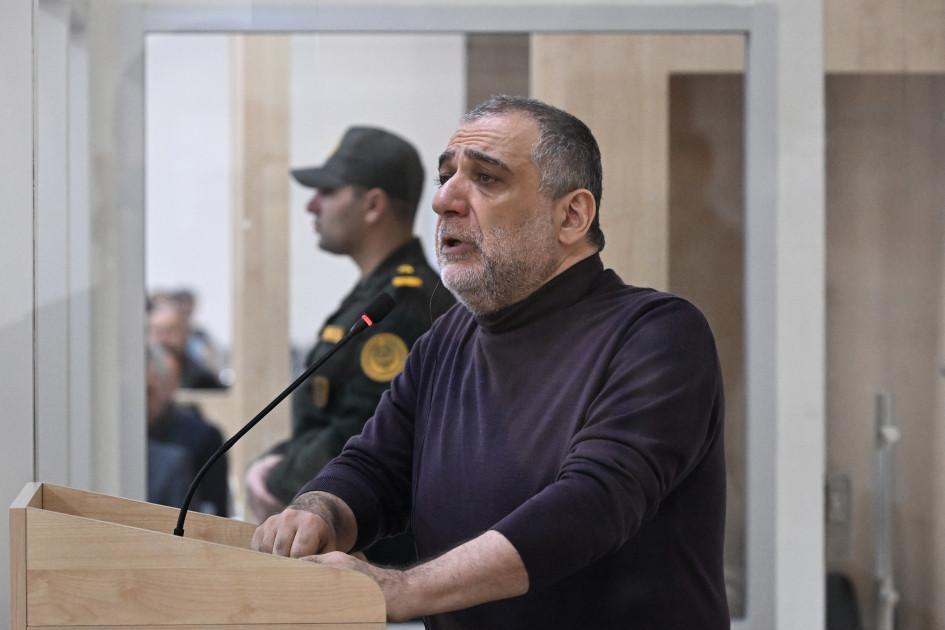
Ruben Vardanyan Calls Baku Court Proceedings a "Judicial Farce"
The family of former Artsakh State Minister Ruben Vardanyan, now on trial in Baku's Military court, released the following statement today.
During a phone call with his family, Ruben Vardanyan conveyed the content of his final statement at his February 10 court hearing.
Refusing to participate in what he described as an imitation of justice, Vardanyan spoke about dignity, responsibility, and peace — all of which, he said, are only possible between equals. Below is the transcript of Ruben Vardanyan’s audio message.
“On February 10, I delivered my final statement in court, instructing my lawyer not to present any defense arguments, because I consider what is taking place not a real trial, but a judicial farce. There has been no genuine possibility for a fair judicial process. Therefore, despite the judges’ resistance, my lawyer remained silent and did not present any arguments or justifications. I, myself, spoke very briefly.
I do not want to repeat what I said in December — I have already addressed my fundamental views. However, I did read an important poem, which I would also like to share with you. In fact, I read two poems in court. Now, I would like to share one of them with you. It probably relates even more to Armenia than to the place where I am now.
This poem was written at the beginning of the 16th century by the Azerbaijani writer Fuzuli, in a Russian translation by Vladimir Lugovskoy.”
Падишах золотой земли подкупает людей серебром,
Он готовит полки для захвата другой страны,
Сотней козней и хитростей он побеждает её,
Но и в этой стране нету радостей и тишины.
И в тот гибельный час, когда рок совершил поворот,
Гибнет сам падишах, и страна, и миллионы людей.
Посмотри: это я властелин, дервиш, сильный войсками слов.
Громоносное слово — источник победы моей.
Видишь, каждое слово моё — великан, что из истины силу берёт,
Если слово захочет, будут море и суша покорны ему.
И куда б я его ни послал, слову чужды почёт и казна;
Слово, взявши страну, никого не заточит в тюрьму.
Все стихии вселенной слово моё не сотрут,
Не раздавит его колесо вероломной судьбы.
Пусть властители мира мне не даруют благ;
У меня в голове есть корона скромной моей резьбы.
Я свободен во всём! Кто б ты ни был, слушатель мой,
Ты не должен за корку хлеба преходящего быть слугой. (For a fleeting crust of bread, do not become a servant.)
And not even for trains of gasoline. What I have said, and what I wish to repeat, is this: we must understand that a long road to peace lies ahead of us, and it will not be easy. We will have to undergo a profound internal renewal and restore ourselves, first and foremost. Because, I repeat, peace can exist only when there are two equal neighbors․
If one side is to humiliate itself before the other, nothing will work. There will be no peace. I hope we come to realize and understand that everything depends solely on us — on our ability to restore ourselves, to respect ourselves, and preserve our sense of reason, without losing the awareness that we truly must live in peace in our region. In court, I said — and repeated three times, even as they tried to interrupt me — that Artsakh has existed, Artsakh exists, and Artsakh will exist in an existential sense. It was, it is, and it will be.
The fact that Artsakh has existed, exists, and will exist is not a legal matter. It is a simple truth that no one can simply erase. I am deeply convinced of this.
I said that I will do everything so that, within our lifetime — within my lifetime, I hope — the leaders of the three sides of the conflict will together lay flowers at the graves of those who perished, regardless of nationality or religion, and ask forgiveness from all mothers for their fallen children. I hope that one day, this will happen, and that it will happen with respect — for everyone, and toward one another.
I also said that I am proud to represent the Armenian people here, in this court. I am not afraid of any punishment or decision and am ready to accept it with complete calm, because what is taking place is not a trial, but a farce.
Unfortunately, they did not use the opportunity. They did not take advantage of the chance to conduct a genuine judicial process that could have laid the foundation for truly long-term peace. Instead, they organized an incomprehensible, unprofessional spectacle which, regrettably, benefitted no one — least of all, the Azerbaijani state itself. I am convinced of this.”
Write a comment