 Videos
 Photos


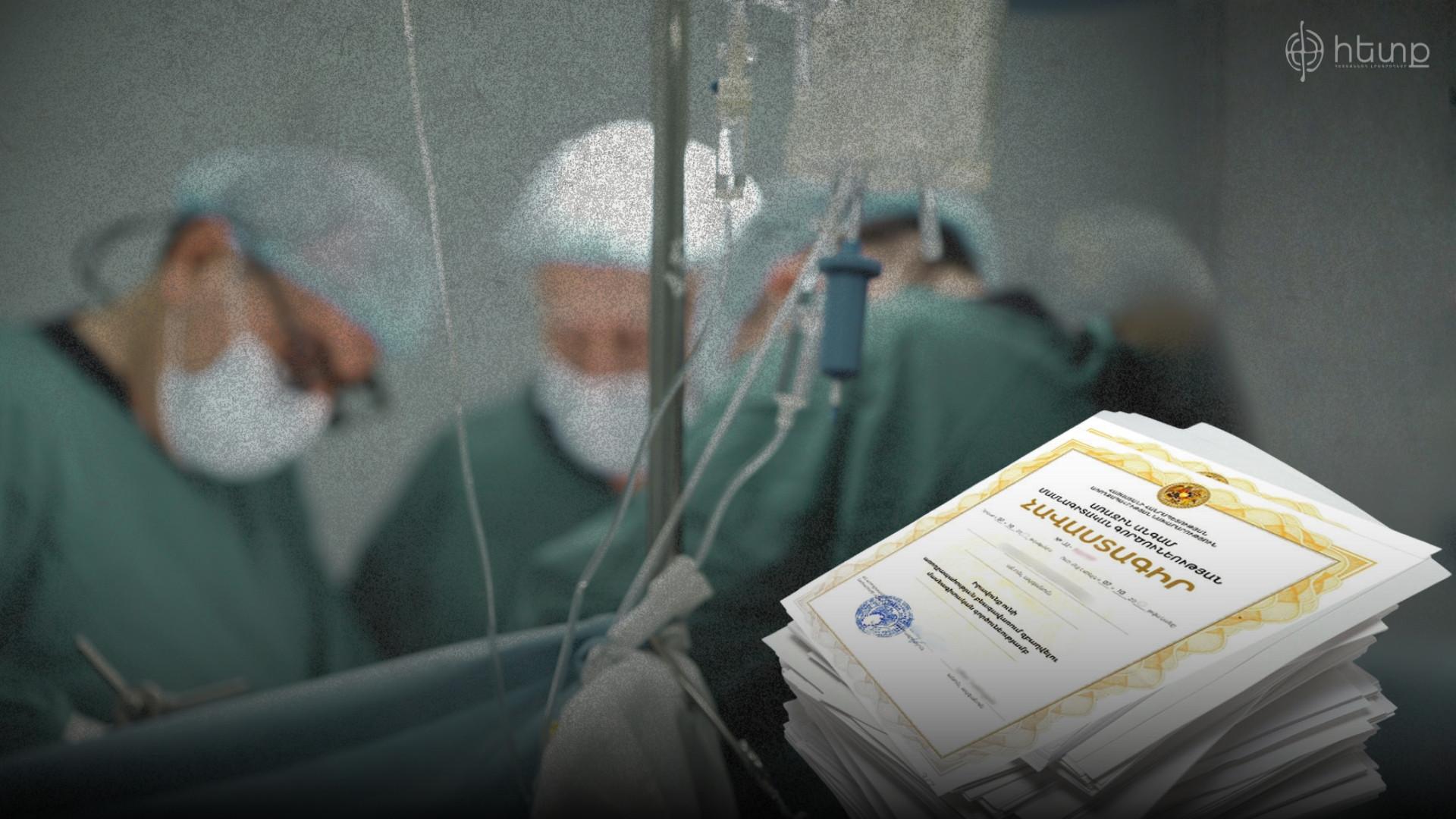
Assessing Medical Malpractice in Armenia: Limited Public Data and Absence of Physician Licensing Present Significant Challenges
We often hear about medical errors only when they’ve resulted in irreversible consequences.
And what happens next, when a doctor is deprived of their license, or their work is suspended?
Journalists from fifty media outlets, in cooperation with the Organized Crime and Corruption Reporting Project (OCCRP), have worked for months to identify doctors who have been stripped of their licenses in one country but continue to work in another.
The Bad Practice investigation shows how deficient supervision, a lack of information, and sometimes the doctors' own irresponsibility render people defenseless. Patients don’t know those to whom they are entrusting their health.
When Hetq tried to find comparable stories in Armenia, it turned out that it’s almost impossible as there is no individual licensing of doctors, nor are there sufficient public data based on which a study could be conducted. For this reason, we simply started searching for Armenian doctors in foreign databases available to us, as well as examining court cases and the certification procedure to understand the mechanisms by which the healthcare system monitors professional quality and ensures patient safety.
Death Due to Medical Error, but No Convictions
In December 2021, 45-year-old Nshan Nshanyan lost consciousness and died during a fractured hand operation at the Artashat Medical Center. The conclusion of the Forensic Science Practical Center, published after an article by Hetq, confirmed that Nshanyan's death was a consequence of medical error. According to the experts' assessment, the patient's pre-operative indicators and the safety rules for anesthesia were ignored. The doctor who performed the surgery continues to work at the same medical center.
Despite the clear formulations of the conclusion, there is still no outcome in the criminal case. The deceased's sister, Lusine Aznauryan, has waited for justice for almost four years, noting that the investigation is being deliberately prolonged.
Two Deaths in One Year
56-year-old Zabel Karapetyan died during a plastic surgery intervention at the Artcosmed Aesthetic Surgery Center, performed by the center's director, surgeon Artur Sargsyan.
The woman, who had arrived from Germany, wanted to remove a small lump on her leg and abdominal fat, but according to her husband, Zareh Karapetyan, the doctor persuaded her to get surgeries on five parts of her body at once. Cardiac arrest was registered on the operating table, and Zabel Karapetyan died without regaining consciousness.
Zareh Karapetyan considers the large volume of general anesthesia to be the cause of death, while Dr. Sargsyan insists that his wife had no contraindications and that the death was caused by an acute myocardial infarction.
The incident took place on October 7, 2024, and one year prior, another 32-year-old woman had died after a surgery performed by the same doctor.
In September 2025, Hetq sent a written inquiry to Armeni’s Investigative Committee (IC) to find out the details of the initiated criminal proceedings. The IC responded that: "Currently, all measures provided for by Armenia’s Criminal Procedure Code are being taken to ensure the comprehensiveness of the preliminary investigation of the criminal proceeding, its normal course, and the timely execution of investigative actions in the manner prescribed by law."
Artur Sargsyan is not currently performing surgeries.
In this and similar cases, criminal proceedings are initiated under Article 187 of the Criminal Code: "Failure to perform or improper performance of professional duties by those providing medical assistance and service."
The article stipulates that causing serious harm to health due to the negligent or dishonest attitude of medical aid providers is punishable by a fine or detention for up to three months. If the act has resulted in the patient's death, imprisonment is set for a term of two to six years, in some cases, also with the limitation of the right to engage in medical activity.
Although criminal proceedings for medical errors are initiated regularly, they rarely result in a conviction. Many cases remain in the preliminary investigation phase for years, and some are closed based on the expiration of the statute of limitations.
2020-2024: 1,172 Criminal Proceedings Initiated, 14 Sent to Court
Between 2020 and 2024, 1,172 criminal proceedings were initiated under Criminal Code Article 187, but only fourteen were sent to court during the same period.
Criminal proceedings initiated in cases of medical error rarely lead to accountability. Between 2020 and 2024, 627 proceedings were terminated before being sent to court, and five were terminated in court. During the same period, six individuals were convicted, and nine were acquitted in seven criminal proceedings.
The course of criminal proceedings does not provide a complete picture of the real mechanisms for monitoring professional quality. For this reason, it is important to understand what procedures are used in Armenia’s healthcare system to monitor the professional qualifications of a doctor and what toolkit is used for this.
Certification is Not a License
The certification of professional activity for medical workers in Armenia has been conducted since 2022 and is regulated by a corresponding decree of the Minister of Health, which sets the procedure for organizing and implementing this process. The organization of the process is conducted by the National Center for Professional Activity Certification of the National Institute of Health, a division of the Ministry of Health.
The certificate is issued in two cases. The first refers to those individuals who have recently completed relevant schooling and are entering the field. They receive a First-Time Professional Activity Certificate for performing professional work in the healthcare field. This certificate is granted for a period of five years, calculated from the moment the final schooling document is issued.
In the second case, the continuity of the professional activity of current medical workers is ensured. Senior and mid-level medical workers must obtain a Continuing Professional Development (CPD) Certificate, which is the permit to continue independent professional activity. The procedure mandates that the medical worker is obliged to apply for a new CPD certificate for the next five years. If the application is submitted late, medical workers bear the risk of being deprived of the right to perform professionally.
Since 2022, and up to and including June 3, 2025, 45,342 medical workers have received a certificate, of which 17,695 are senior medical workers, 23,010 are mid-level, 1,000 are pharmacologists, and 3,637 are pharmacists.
The issuance of a certificate can only be rejected on clear grounds established by law. These include, for example, the falseness of the submitted documents or the inconsistency of the profession indicated in the application with the final educational document, and so on.
National Institute of Health (NIH) Director Aleksandr Bazarchyan notes that the certificate cannot be suspended or revoked because it is not a license; rather, the order of the authorized body can be revoked in the presence of legal grounds.
"The certificate simply shows that the medical worker's educational path complies with the requirements of the law. Over the last five years, they must have accumulated the necessary educational credits, which can be obtained through CPD courses, participation in scientific meetings and conferences, and the defense of a candidate/doctoral dissertation.
The certificate confirms this educational path, which is why it is technically impossible to deprive someone of it,” the institute's director notes.
Thus, the certificate is merely a document confirming the medical worker's educational path; it is not suspended or revoked but can only be declared invalid when there is a paperwork issue.
On August 8, 2025, Armenia’s Health and Labor Inspectorate (HLI) reported that it revealed fourteen cases of forgery of educational diplomas and certificates by medical workers. The inspectorate, In response to our inquiry, wrote that "the medical workers with forged diplomas were mainly plastic surgeons, physician-cosmetologists, dentists, and nurses."
Armenia’s National Institute of Health (NIH) informed Hetq that these were diplomas obtained in Russia.
"One must understand that there are diplomas obtained in a directly false manner, and there are completely bogus, non-existent diplomas. Those fourteen cases involved Russian diplomas that were real, legal diplomas in the Russian Federation. People simply obtained them through a non-standard procedure; that is, the document is genuine, but the manner of obtaining it was fake. We have an intergovernmental agreement with Russia, and we mutually recognize each other's diplomas without unnecessary procedures. But in these cases, suspicions arose during the check, and the inspectorate contacted the national center for mutual recognition," notes NIH Director Aleksandr Bazarchyan.
Armenia’s HLI petitioned the authorized body to examine the issues of suspending the professional activity of the mentioned medical workers, as well as declaring the CPD certificates granted them as invalid.
All Senior Medical Workers Will Have Individual Licenses by January 2027
A new phase is beginning in Armenia’s healthcare system in 2025. Medicine is officially becoming an individual activity subject to licensing. By a government decision, the regulation setting out the forms for medical workers to obtain individual and transitional licenses came into effect on August 1.
The National Institute of Health informed Hetq that the process has already started. According to the institute's director, first-year clinical residents are already participating in the licensing process this year.
According to the new system, a license will be granted for a five-year term with the possibility of automatic extension if the medical worker continues the professional educational path, undergoes certification, and has no legal violations or other restrictions established by law. In case of suspension or termination, accountability is no longer borne by the medical institution but by the medical worker.
Bazarchyan also notes that this change is important not only from the point of view of internal regulation, but also international recognition. Individual licenses will become the main document required for Armenian doctors to work abroad.
Armenia is newly transitioning to an individual licensing system, and this is an opportunity to fundamentally change the logic of professional regulation. The license must establish clear criteria as to who has the right to engage in medical activity and how the state responds to professional errors.
Write a comment